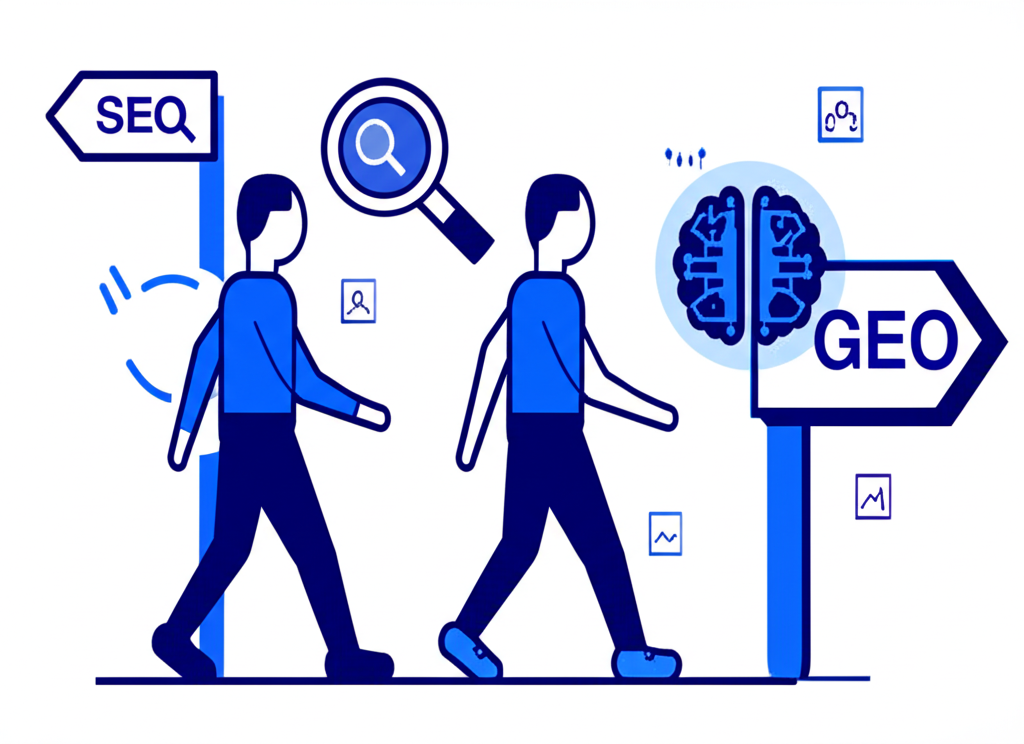
The question isn’t “SEO or GEO” — it’s “how do I add GEO without blowing up what’s working?”
If you’re running an SEO agency in 2026, you’ve already felt the pressure. Clients are asking about AI search. Some have seen their organic traffic decline despite stable rankings. Others have read about ChatGPT’s impact on search behavior and want to know what you’re doing about it.
The good news: you’re not starting from zero. Everything your agency already knows about technical SEO, content optimization, and E-E-A-T (Experience, Expertise, Authoritativeness, Trustworthiness) is still valuable. GEO is an evolution of SEO, not a replacement.
The bad news: if you wait too long, someone else will pitch your clients on AI visibility — and that someone might become their new agency.
This guide is a 10-week playbook for transitioning from an SEO-only agency to one that delivers both SEO and GEO services. No theoretical frameworks. Just the practical steps to audit, pilot, package, and sell GEO alongside your existing offering.
TL;DR — How SEO Agencies Transition to GEO
GEO is an evolution of SEO, not a replacement — your existing skills transfer directly
Add schema markup, citation-ready content structure, and multi-platform AI visibility
Follow a 10-week plan: audit your own site → pilot with 2-3 clients → package services → update proposals
GEO services can add $216K–$616K to agency ARR in Year 1
Add BlueJar to your stack; keep Ahrefs, Screaming Frog, and GSC
Why SEO Agencies Can’t Ignore GEO
Here’s the data that should drive urgency:
AI Overviews now appear in 25.11% of Google searches. Your clients’ organic traffic is being displaced by Google’s own AI answers — and the websites cited in those answers aren’t necessarily the ones ranking #1 in traditional results.
93% of AI search sessions end without a website click. This means the value is shifting from “getting clicks” to “being the cited source” — a fundamentally different optimization target.
Zero-click searches hit 69% in 2025. Between featured snippets, knowledge panels, and AI Overviews, more than two-thirds of searches never result in a click. If your entire client value proposition is “more organic clicks,” you’re selling a declining metric.
54% of US marketers plan to implement GEO within 3-6 months. Your clients’ competitors are moving. If your agency can’t provide GEO services, your clients will find an agency that can.
ChatGPT processes roughly 12% of Google’s daily search volume. This isn’t a side channel — it’s a major search platform that your clients have zero visibility strategy for.
The retention risk is real: agencies that can’t speak to AI visibility in 2026 will lose clients to agencies that can. The revenue opportunity is also real: GEO services typically add $500-$3,000/month per client retainer on top of existing SEO work.
What’s Different About GEO (The 6 Core Shifts)
Understanding the differences between SEO and GEO optimization is the first step in the transition. Here are the six fundamental shifts your team needs to internalize:
Audit for citation readiness, not keyword density. In SEO, you optimize for keyword relevance and ranking signals. In GEO, you optimize for whether AI can confidently extract, quote, and cite your content. The question shifts from “does this page rank for the keyword?” to “would an AI system quote this page when answering a question?”
Schema markup becomes critical, not optional. In traditional SEO, schema markup is a “nice to have” — it might get you rich snippets but doesn’t directly affect rankings. In GEO, structured data is how AI systems understand what your content is about, who wrote it, and whether the source is credible. Websites with structured data earn 44% more AI citations than those without (BrightEdge 2025).
Zero-click is a win, not a loss. In SEO, a zero-click result means a missed visitor. In GEO, being the cited source in a zero-click AI answer is the goal. Your client’s brand, expertise, and recommendation appear in the answer — driving brand authority and downstream conversions even without a click.
Content format matters more than content length. SEO often rewards comprehensive, long-form content. GEO rewards content that’s structured for extraction — clear headings, direct answers, FAQ format, bullet points, and quotable statistics. A well-structured 1,500-word page may outperform a 5,000-word rambling guide in AI citations.
Brand entity is a ranking factor. AI systems evaluate brand reputation and entity information when deciding what to recommend. Your client’s Google Knowledge Panel, Wikipedia presence, Crunchbase profile, and social media consistency all influence AI citation. Entity SEO becomes a core service.
Platform diversity: 6 AI platforms, not just Google. SEO focuses on Google (and sometimes Bing). GEO requires visibility across ChatGPT, Perplexity, Google AI Overviews, Claude, Gemini, and Microsoft Copilot. Each platform has different content evaluation criteria. Your optimization strategy needs to account for multi-platform visibility.
The transition from SEO to GEO is a strategic evolution, not a replacement
What Stays the Same (Don’t Throw Out Your SEO Stack)
Before your team panics about learning an entirely new discipline, here’s the reassurance: GEO is built on the same foundation as SEO. The core principles that make a website rank well in traditional search also contribute to AI visibility.
Technical foundation still matters. Site speed, crawlability, mobile optimization, clean URL structure, and proper canonical tags — all of this is still foundational for GEO. AI platforms crawl websites the same way search engines do. A technically broken site won’t get cited.
Quality content still wins. AI systems don’t cite thin, spammy, or low-quality content. The same content standards that drive SEO success — depth, accuracy, originality, expertise — apply to GEO.
E-E-A-T is amplified, not replaced. Experience, Expertise, Authoritativeness, and Trustworthiness matter even more in GEO. AI systems actively look for credentialing signals (author expertise, source reputation, citation quality) when deciding what to recommend. Your existing E-E-A-T work directly transfers.
Backlinks still signal authority. External links to your client’s content still indicate quality and authority. AI systems consider backlink signals as part of their content evaluation. Your link building work continues to produce value.
The practical implication: your team doesn’t need to learn an entirely new discipline. They need to add a GEO layer on top of their existing SEO expertise. That layer is primarily about schema markup, content structuring, and multi-platform visibility.
The 4-Step Agency Transition Plan
Step 1: Audit Your Own Agency Site First (Week 1-2)
Before you sell GEO to clients, optimize your own agency website. This serves three purposes: you learn the process, you build internal case study data, and you practice what you preach.
Run a GEO audit on BlueJar for your agency’s website. Record your baseline score.
Implement Organization schema on your homepage
Add FAQ schema to your services pages
Add Author schema to your blog posts
Restructure your top 5 blog posts for AI citation readiness (clear headings, FAQ sections, quotable statistics)
Re-audit after implementation. Document the score improvement — this becomes your sales proof point.
Step 2: Pilot With 2-3 Existing Clients (Week 3-6)
Select 2-3 clients who meet these criteria: they’ve expressed interest in AI search, their websites have significant room for GEO improvement, and they’re open to a pilot program.
Run GEO audits on pilot client websites
Present findings as a “complementary AI visibility assessment” (position it as added value, not an upsell — yet)
Implement the top 5 recommendations for each pilot client
Track results over 30 days: GEO score improvement, AI citation changes, and any measurable traffic or brand query changes
Document the process, time investment, and results for each pilot
The pilot phase is critical because it gives you real data. “We improved Client X’s AI visibility score from 28 to 54 in 30 days” is infinitely more persuasive than “we think GEO is important.”
Step 3: Package and Price GEO Services (Week 7-8)
Based on your pilot data, define your GEO service tiers:
Tier 1: GEO Audit (one-time) — $500-$2,500 depending on site size. Deliverable: full AI visibility assessment with scored report and 30-day fix plan.
Tier 2: GEO Optimization Sprint (3-month project) — $2,500-$10,000. Deliverable: schema implementation, content restructuring, FAQ optimization, and competitive positioning for AI search.
Tier 3: GEO Monitoring Add-On (monthly retainer) — $500-$2,000/month. Added to existing SEO retainer. Deliverable: monthly AI citation tracking, quarterly optimization, competitive benchmarking.
Tier 4: Full GEO + SEO Retainer (monthly) — $3,000-$8,000/month. Combined traditional SEO and AI visibility optimization under one engagement.
Step 4: Update Proposals and Pitch Decks (Week 9-10)
Every new proposal and client pitch should now include GEO:
Add an “AI Visibility” section to your standard proposal template
Include a quick-scan GEO score for every prospect website (run a 5-minute audit before each pitch)
Update your case studies to include AI visibility metrics alongside traditional SEO metrics
Add GEO to your website services page with clear service descriptions
Update your pitch deck with AI search market data (25% AI Overviews, 93% no-click, 12% ChatGPT volume)
Agencies that add GEO services early gain a first-mover advantage with clients
Updating Your Team’s Skill Set
The skill gap between SEO and GEO is smaller than most agency owners expect. Here’s what your team needs to learn, mapped to existing roles:
Multi-platform visibility testing (ChatGPT, Perplexity, Google AI, Claude)
Content strategists need to learn:
Citation-oriented content structuring (direct answers, FAQ format, quotable statistics)
Entity optimization: building brand entity signals across the web
Author credentialing: creating and optimizing author bios with schema markup
Comparison content strategy for AI search
Account managers need to learn:
How to explain GEO to clients in simple terms
How to read and present GEO audit reports
How to position GEO as a complement to SEO, not a replacement
How to handle the objection “we’re already ranking on Google”
Budget 2-4 hours per week for 4 weeks for team training. Most agencies can have their team GEO-competent within 30 days.
Adding GEO to Your Existing Client Retainers
The fastest revenue path is expanding existing retainers, not selling new clients. Here’s how to approach the conversation with current SEO clients:
The framing that works: “We’ve been monitoring a shift in how search works, and we want to make sure your investment in SEO is protected. AI search is growing — and the good news is, most of the SEO work we’re already doing positions you well. We’re recommending a small expansion to cover AI visibility, so you’re not losing ground as search behavior changes.”
This framing works because it:
Positions GEO as protecting the existing SEO investment (not a new expense)
Validates the work you’ve already done together
Creates urgency without fear-mongering
Keeps the expansion “small” (even if the revenue increase is significant)
The “AI Visibility Add-On” approach:
Run a GEO audit on the client’s site (5 minutes using BlueJar)
Add a one-page “AI Visibility Status” section to your next monthly report
Show their GEO score alongside their SEO metrics
Propose a $500-$1,500/month add-on to address AI visibility within the existing engagement
Most agencies find that 30-50% of existing clients accept the add-on when presented with their GEO score and competitive data. If a client sees their competitor scoring 65 while they’re at 28, the conversation practically closes itself.
Sales Positioning: How to Talk About GEO to SEO Clients
Different client types respond to different angles. Here are positioning scripts for the most common client profiles:
For the data-driven client:
“AI Overviews appear in 25% of Google searches. ChatGPT processes 12% of Google’s daily volume. 69% of searches are zero-click. Your current SEO strategy is optimized for a search landscape that’s changing. GEO ensures your visibility extends to the AI layer — where 54% of your competitors are planning to invest in the next 6 months.”
For the competitive client:
“I ran a quick AI visibility check on your site and your three main competitors. You’re scoring 32, and [Competitor A] is at 58. When a potential customer asks ChatGPT about [their category], [Competitor A] is being recommended. Let me show you what they’re doing differently.”
For the risk-averse client:
“Everything we’re doing in SEO is still working and still important. But search is adding an AI layer, and we want to make sure your site is optimized for both traditional results AND AI results. Think of GEO as insurance — protecting the organic visibility you’ve already built.”
For the budget-conscious client:
“Most of the GEO work layers directly onto what we’re already doing. The additional investment is $X/month, and it covers schema markup, content restructuring for AI citation, and monthly AI visibility monitoring. Given that AI referral traffic converts at 4.4x traditional search, even a modest increase in AI visibility can pay for the investment quickly.”
The Tools You Need to Deliver GEO Services
You don’t need to replace your existing SEO stack. You need to add one or two GEO-specific tools:
Add to your stack:
BlueJar — GEO audits, AI visibility scoring, citation tracking, and AI fix recommendations. The Agency plan includes white-label reports and high-volume capacity for client delivery at scale.
Keep in your stack:
Ahrefs/SEMrush — keyword research, backlink analysis, site audits (still essential)
Screaming Frog — technical crawling (now also validate schema implementation)
Google Search Console — performance monitoring (still your primary data source for Google)
GA4 — traffic and conversion tracking (add AI referral source segmentation)
Clearscope/SurferSEO — content optimization (use with a GEO lens: optimize for entity coverage and FAQ format)
Add to your workflow:
Google Rich Results Test — validate all schema markup before deployment
Schema.org validator — for advanced schema validation
Manual AI testing — monthly queries across ChatGPT, Perplexity, Google AI for client brands
Total additional tool cost for the transition: see bluejar.ai/pricing — plans scale from individuals to agencies. At even one additional client retainer expansion ($1,000/month), the tools pay for themselves immediately.
Revenue Impact: What GEO Services Add to Agency ARR
Let’s model the revenue impact for a typical SEO agency:
Starting point: 20 SEO clients, average retainer $3,000/month. Total ARR: $720,000.
GEO expansion scenario (conservative):
8 of 20 existing clients accept the GEO add-on at $1,000/month average = $96,000 additional ARR
4 one-time GEO audits per quarter at $1,500 average = $24,000/year
2 new clients won specifically because of GEO positioning at $4,000/month = $96,000 additional ARR
Total Year 1 GEO revenue: ~$216,000 (30% increase over baseline ARR)
GEO expansion scenario (aggressive):
14 of 20 clients accept GEO add-on at $1,500/month average = $252,000 additional ARR
8 one-time audits per quarter at $2,000 average = $64,000/year
5 new GEO-positioned clients at $5,000/month = $300,000 additional ARR
Total Year 1 GEO revenue: ~$616,000 (86% increase over baseline ARR)
The margins on GEO services are strong because they leverage your existing team’s expertise and add tool costs of $150-$1,000/month. There’s no significant new infrastructure or headcount required in Year 1.
Frequently asked questions
How long does the transition take?
Using the 10-week plan above, you can have GEO services packaged and available within 2.5 months. Most agencies start generating GEO revenue within the first month of the transition (from audit deliverables).
Do I need to rebrand my agency?
No. Don’t rebrand as a “GEO agency” — position yourself as a search visibility agency that covers both traditional and AI search. Keep your SEO identity and add GEO as an additional capability. Rebranding creates unnecessary confusion for existing clients.
Will GEO cannibalize our existing SEO retainers?
It shouldn’t. GEO adds to SEO; it doesn’t replace it. The risk is actually the opposite: if you don’t add GEO, a competitor agency will — and they might take the entire retainer, including the SEO component.
What if I don’t have technical expertise for schema markup?
If your agency lacks technical SEO capabilities, partner with a development resource for schema implementation. The audit and strategy work doesn’t require deep technical skills — just the implementation does. Alternatively, many GEO tools (including BlueJar) provide code-ready schema markup that a junior developer can implement.
How do I report GEO results to clients?
Add an “AI Visibility” section to your monthly client reports. Include: GEO Score trending, AI citation count across platforms, competitive benchmarking, and actions taken that month. This mirrors the SEO reporting your clients are already accustomed to.
Is GEO just a buzzword that will fade?
AI search volume is growing, not shrinking. ChatGPT’s search share, Google’s AI Overview coverage, and Perplexity’s user base are all on steep growth curves. GEO as a term may evolve, but the underlying need — optimizing for AI-powered search — is a permanent shift in how search works.
What if my clients’ industries aren’t affected by AI search yet?
Every industry is affected — the question is degree. B2B SaaS, professional services, healthcare, legal, and ecommerce are seeing the highest AI search impact today. Local services, manufacturing, and niche B2B verticals are experiencing slower adoption but still growing. The time to prepare is before the impact hits, not after.
How long does it take an SEO agency to transition to offering GEO services?
A focused agency can develop GEO service delivery capability within 4-8 weeks. This includes: 2 weeks of team training on GEO concepts and BlueJar platform, 1-2 weeks running pilot audits on internal/client sites, 1 week developing service pricing and deliverable templates, and 1-2 weeks of client communication and positioning updates. Many agencies start offering GEO audits as a new service line while still developing full implementation capacity.
Do SEO agency team members need to retrain for GEO services?
SEO fundamentals transfer well to GEO — understanding content quality, technical optimization, and authority signals is directly relevant. The new skills required: JSON-LD schema markup implementation (more important in GEO than traditional SEO), AI platform behavior and citation patterns, and GEO-specific metrics and reporting. Most SEO specialists can develop GEO competency with 20-40 hours of focused learning.
Can agencies charge more for GEO services than traditional SEO?
Yes, typically. GEO is a newer, less commoditized service. Market rates for GEO audits ($500-$2,000) and GEO retainers ($500-$1,500/mo additional) are comparable to premium SEO service rates but with lower competitive pressure. The ROI narrative for GEO (‘be cited in ChatGPT before your competitors’) is compelling to clients and supports premium pricing.
How do agencies handle GEO vs SEO service overlap?
Treat GEO as complementary to SEO, not competitive. Many improvements help both (content quality, schema markup, brand authority). Position them as separate service lines with separate deliverables and billing. A typical agency client might have a monthly SEO retainer and a quarterly GEO audit + ongoing implementation package. The key is making GEO tangible with concrete deliverables (GEO Score, dimension breakdown, fix list) that clients can track over time.
About the author
Suresh ParakotiFounder & Growth Lead, BlueJar
Suresh Parakoti is Founder at BlueJar, focused on growth and helping agencies add AI visibility services. He writes about GEO strategy for agencies, consultants, and B2B companies.