Key Takeaways
- 25% of car buyers now use AI tools like ChatGPT during purchase research, jumping to 40% among undecided shoppers (CarEdge, 2025).
- ChatGPT dominates AI-assisted car shopping at 68.4% usage, with 97% of AI users saying it will influence their purchase decision (Ekho, 2026; Cars.com, 2025).
- AI visibility is 30x harder than local SEO — ChatGPT recommends only 1.2% of business locations vs. 35.9% in Google’s local 3-pack (SOCi, 2026).
- 76.6% of AI citations come from informational content like buying guides and comparisons, not inventory pages (C-4 Analytics, 2025).
- AI referral traffic converts at 15.9% vs. 1.76% for organic search — a 9x advantage for dealerships that get cited (Seer Interactive, 2025).
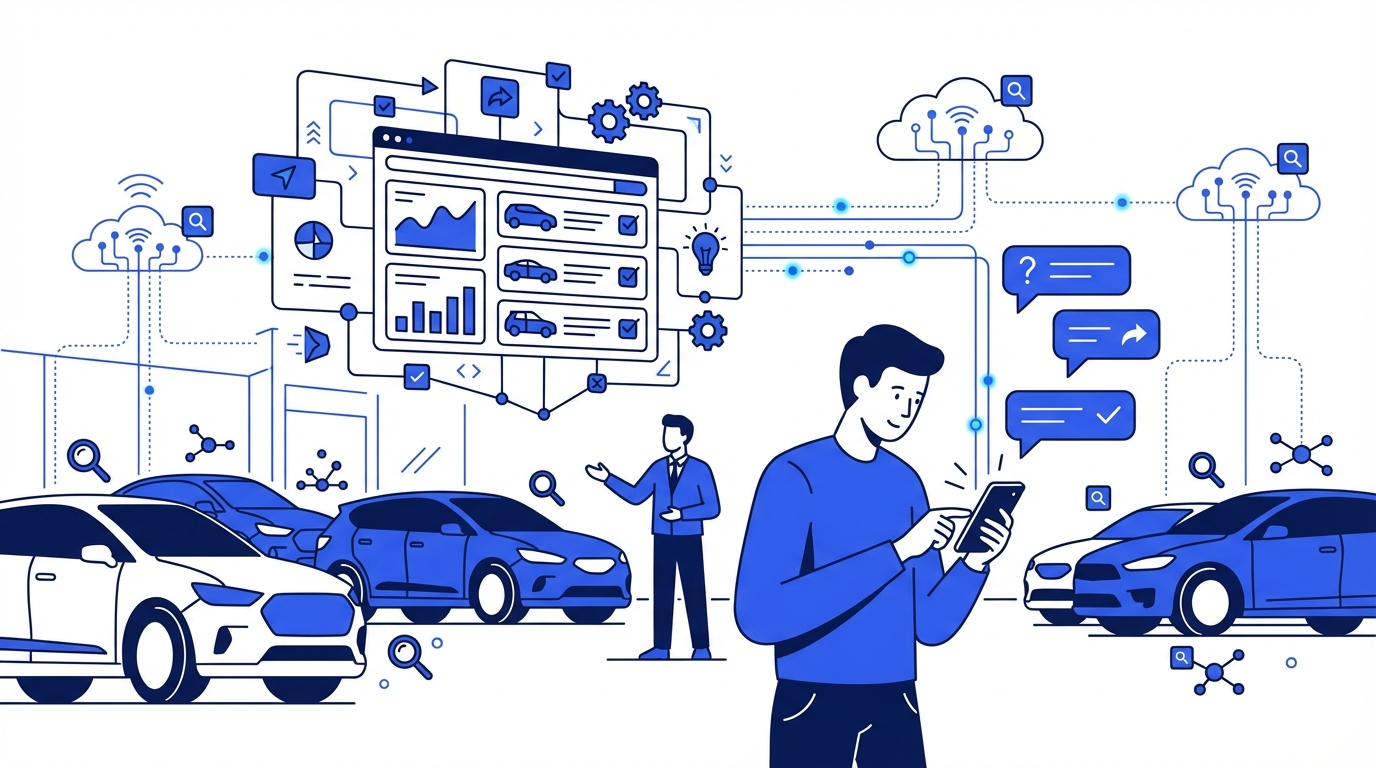
AI Is the New Showroom Floor
Picture this. A buyer in Plano, Texas types into ChatGPT: “Best Honda dealers near Dallas with good service departments.” ChatGPT returns three names. Your competitor two miles down the highway is one of them. You are not.
That buyer never visits your website. Never sees your inventory. Never walks into your showroom. The deal is lost before you even knew there was one to lose.
This is not a hypothetical scenario. It is happening right now, at scale, across every metro area in the country. And the shift is accelerating faster than most dealership operators realize.
A CarEdge survey of 500 U.S. respondents found that 25% of car buyers in 2025 used or planned to use AI tools like ChatGPT during the shopping or buying process (CarEdge, 2025). Among those who had not yet purchased, that number jumped to 40%. Of the buyers who did use AI, 88% said the tools were helpful for navigating the car buying process. These are not tire-kickers experimenting with a novelty. They are serious buyers who found a better way to research.
The data gets more aggressive from there. Ekho’s 2026 AI Vehicle Research Study found that 30% of in-market vehicle shoppers used AI during their research process (Ekho, 2026). That is nearly one in three buyers on your lot right now who have already formed opinions about dealerships based on what an AI told them. ChatGPT dominated tool usage at 68.4% of all AI-assisted car shopping activity, outpacing YouTube (25.3%), social media (16.2%), and traditional marketplaces (12.7%) as a research channel (Ekho, 2026).
Cars.com surveyed 936 respondents in November 2025 and found that 97% of AI users said AI would influence their purchase decision (Cars.com, 2025). Not “might.” Will. And 44% had already used AI-powered car search tools during their shopping journey.
Here is the statistic that should make every dealership GM sit up: 41% of shoppers said they would visit a cited dealer’s or manufacturer’s website after getting an AI recommendation (Cars.com, 2025). That means if ChatGPT names your competitor, four out of ten buyers go straight to that competitor’s site.
“Car shoppers aren’t treating AI as a novelty — they’re using it as a trusted co-pilot in their research.”— Matt McDonald, Cars.com
Think about what that means for the traditional dealership marketing model. You spend money on Google Ads to get clicks. You spend money on third-party leads from AutoTrader and Cars.com. You spend money on TV and radio to build brand awareness. But an increasing share of your potential customers are bypassing all of those channels and going straight to an AI that synthesizes information from across the internet and returns a short list of recommended dealerships.
The funnel has changed. The first handshake between a buyer and a dealership used to happen on a Google search results page or on the lot. Now it happens inside a conversation with an AI. If your dealership is not part of that conversation, you are invisible during the most critical phase of the buyer’s journey.
Why Your Dealership Is Invisible to AI
Most dealership owners assume that good Google rankings translate to good AI visibility. They do not.
An Ahrefs study of 300,000 keywords found that the presence of an AI Overview in Google search results correlated with a 34.5% lower click-through rate for the top-ranking organic result (Ahrefs, 2025). A follow-up analysis using December 2025 data showed that number had grown to 58%. Ranking number one on Google no longer means what it used to. AI is intercepting the click.
But the gap between traditional search and AI recommendations is even more dramatic than a CTR drop. SOCi’s 2026 Local Visibility Index analyzed nearly 350,000 locations across 2,751 multi-location brands and found that ChatGPT recommended only 1.2% of business locations, compared to a 35.9% appearance rate in Google’s local 3-pack (SOCi, 2026). AI visibility is not marginally harder than local SEO. It is 30 times harder.
SOCi also found only 45% overlap between the brands that lead in traditional local search and those that lead in AI recommendations (SOCi, 2026). Being the local SEO champion does not make you the AI champion. They are different games with different rules.
So why are dealerships specifically invisible? Three structural reasons.
1. Inventory pages are invisible to AI crawlers
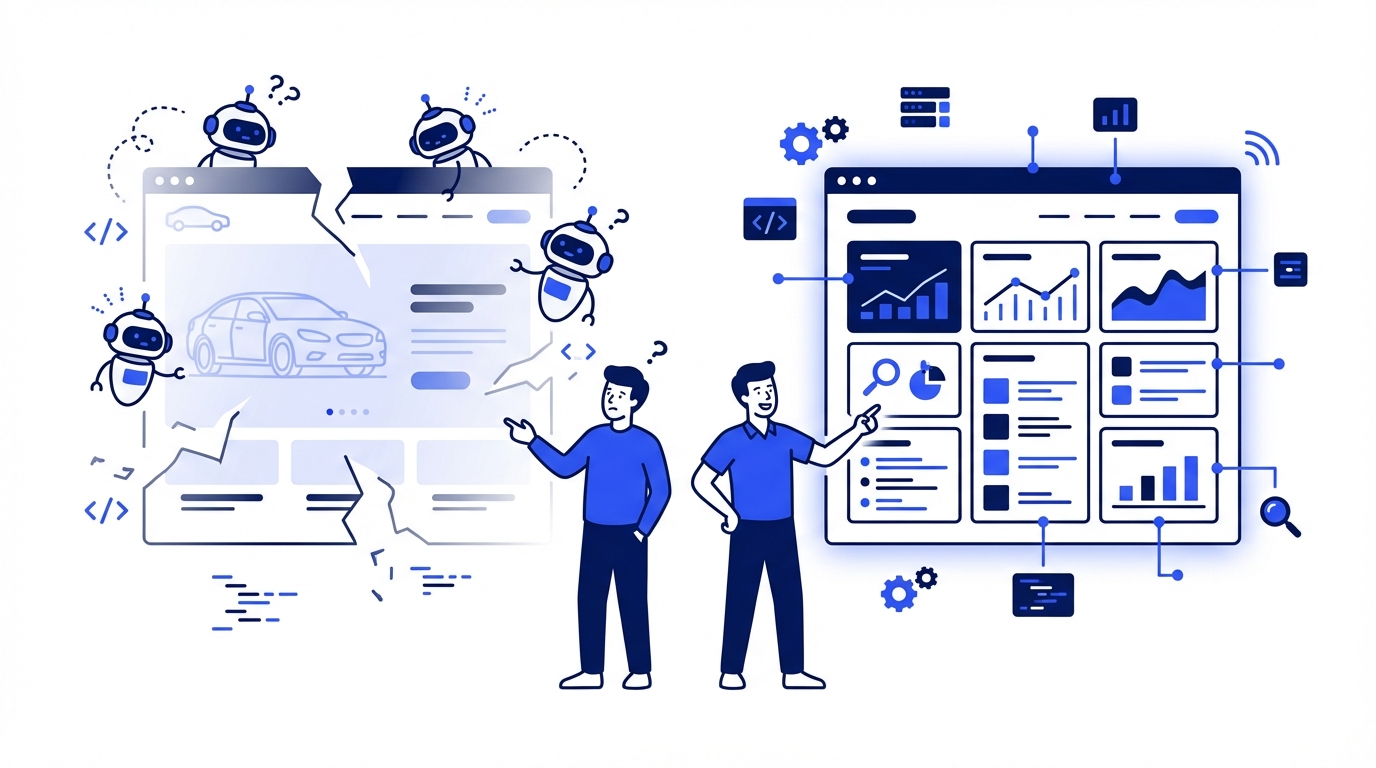
Most dealership websites are built on platforms like Dealer.com, DealerOn, or custom solutions that render inventory through JavaScript-heavy, image-heavy dynamic pages. AI crawlers — the bots that feed data to ChatGPT, Google AI Overviews, and Perplexity — cannot parse this content reliably. Your 400 vehicles might as well not exist as far as the AI is concerned. These crawlers need clean, text-based, server-rendered HTML to ingest content. When your inventory page requires JavaScript execution to display vehicle data, most AI systems simply skip it.
2. Missing structured data
Very few dealership websites implement AutoDealer or Vehicle schema markup. Without this structured data, AI systems have no standardized way to understand what your business is, what you sell, what services you offer, or where you are located. You are asking AI to piece together your identity from unstructured HTML, and it is not going to bother when there are competitors that provide this data in a clean, machine-readable format. Schema markup is the language AI speaks. Without it, you are mute.
3. Review signals are not structured on-site
Your dealership might have 1,200 Google reviews at 4.6 stars, but if that reputation data is not reflected on your website through structured AggregateRating schema, AI systems have a harder time connecting your reviews to your business entity. The reviews exist, but the signal is not being transmitted in a format AI can consume. AI tools like ChatGPT synthesize data from multiple sources — Google Maps, Yelp, Facebook, your website, and third-party review aggregators. If your own website does not confirm and structure that review data, the AI has a weaker confidence signal when deciding whether to recommend you.
What AI Actually Looks For in a Dealership
Understanding what AI ignores is only half the equation. You need to know what it actively seeks out.
C-4 Analytics conducted a nationwide study across 151 dealership domains in July 2025 and found that 85% had at least one unique URL cited in Google AI Overviews (C-4 Analytics, 2025). That sounds encouraging until you look at what was actually getting cited.
Informational content gets cited, not inventory
Of the queries that triggered AI Overview citations for dealership domains, 76.6% were informational intent queries (C-4 Analytics, 2025). These are queries like “best SUVs for families in 2026” or “how to negotiate a car lease” — not “2025 Honda CR-V for sale Dallas.” Blogs, buying guides, and educational content are what AI pulls from. Your inventory detail pages (VDPs) are not earning citations.
This means the dealerships getting recommended by AI are the ones publishing useful, informational content that answers buyer questions. The ones relying solely on their inventory feed and a few thin landing pages are getting skipped entirely.
To put it bluntly: your VDP for a 2025 Honda CR-V is not going to get cited in an AI Overview. But your blog post titled “2025 Honda CR-V vs. Toyota RAV4: Which Is Better for Dallas Families?” absolutely can. The dealerships winning in AI are content publishers first and vehicle listers second.
Citation frequency is a ranking factor
Research into AI answer generation has shown that citation frequency — how often a source is referenced across the web — accounts for approximately 35% of AI answer inclusions. If your dealership’s content is cited and referenced by other sites, AI treats it as more authoritative. A single blog post sitting on your domain with no external references carries less weight than a resource that other publications link to and reference.
This has practical implications for dealership marketing. Sponsoring local events and getting mentioned in local news coverage is not just a branding exercise anymore — it builds citation authority that AI systems can detect. Partnerships with local media, community organizations, and industry publications create the web of references that AI uses to assess trustworthiness.
Reviews are a threshold signal, not a ranking factor
SOCi found that locations recommended by ChatGPT averaged 4.3 stars, compared to 3.9 stars for Gemini and 4.1 for Perplexity (SOCi, 2026). There appears to be a floor — fall below roughly 4.0 stars and AI is unlikely to recommend you. But above that threshold, other signals (content quality, structured data, citation volume) determine whether you get named or not.
For dealerships, this is actually good news. The automotive industry averages around 4.2 stars on Google, which means most dealerships clear the threshold. The differentiator is everything else: structured data, content quality, and citation authority. Reviews get you into the conversation. Everything else determines whether AI picks you over the dealer down the street.
The schema stack AI expects
For dealerships, the structured data types that matter most are:
- AutoDealer — Tells AI this is a car dealership, not a generic local business.
- Vehicle / Car — Provides machine-readable vehicle inventory data.
- LocalBusiness — Core location data: address, phone, hours, service area.
- AggregateRating — Surfaces your review score and count in a structured format.
- Service — Describes service department offerings (oil change, tire rotation, body shop).
Without this schema stack, your dealership is a black box to AI. With it, you are giving AI exactly the structured information it needs to confidently recommend you.
AI Platform Comparison for Car Shopping
| Feature | ChatGPT | Perplexity | Google AI Overviews |
|---|---|---|---|
| Primary Data Source | Web crawl + partnerships (e.g., Yelp, Reddit) | Live web search + citations | Google Search index + Knowledge Graph |
| Content Preference | Informational guides, reviews, structured FAQ content | Recent articles, expert reviews, comparison data | Authoritative pages with schema markup, local listings |
| Review Threshold | 4.3+ stars average for recommendations | 4.1+ stars; weighs review recency | Pulls from Google Business Profile directly |
| Key Schema Needed | AutoDealer, Vehicle, AggregateRating, FAQPage | AutoDealer, LocalBusiness, Article | AutoDealer, Vehicle, LocalBusiness, AggregateRating |
| Market Share (Auto) | 68.4% of AI-assisted car shopping | Growing; strong with research-heavy buyers | Appears on 30%+ of automotive queries |
The 5-Step GEO Fix for Dealerships
GEO — Generative Engine Optimization — is the practice of making your business visible and citable by AI systems. Here is the specific playbook for dealerships.
Step 1: Add AutoDealer + Vehicle JSON-LD Schema to Every Inventory Page
This is the foundation. Every vehicle detail page (VDP) on your site should include JSON-LD structured data with the Vehicle or Car schema type, nested inside your AutoDealer schema. This tells AI crawlers exactly what vehicle is on the page, its price, mileage, condition, and which dealership is selling it.
If your website platform does not support custom schema injection, this needs to become a requirement in your next vendor conversation. Some platforms like Dealer Inspire and DealerOn have schema capabilities, but they are often incomplete or disabled by default. Ask your vendor specifically: “Does our site output AutoDealer and Vehicle JSON-LD on every VDP?” If the answer is no or uncertain, you have found your first optimization priority.
A properly structured VDP should include the vehicle make, model, year, trim, price, mileage, condition (new or used), VIN, and the dealership entity that is selling it — all in JSON-LD format that AI crawlers can read without rendering JavaScript.
Step 2: Create Informational Content That Answers Buyer Questions
The C-4 Analytics data is unambiguous: 76.6% of dealership citations in AI Overviews came from informational queries (C-4 Analytics, 2025). You need content that answers the questions buyers are asking AI.
Build out content around:
- Model comparison guides (“2026 Honda CR-V vs. Toyota RAV4 vs. Hyundai Tucson”)
- Buying process guides (“How to get pre-approved for an auto loan in Texas”)
- Local market content (“Best family SUVs for Dallas commuters”)
- Service and maintenance guides (“When to replace brake pads: mileage guide”)
- Lease vs. buy calculators and explainers
This content does not need to be long-form. It needs to be specific, factual, and structured so AI can extract clear answers from it. Aim for content that answers a single question thoroughly, includes named data points, and is organized with clear headings. Think of each blog post as a briefing document that an AI can quote from when a buyer asks a related question.
Step 3: Bridge Review Signals With AggregateRating Schema
Your Google reviews are powerful, but AI systems do not always connect your Google Business Profile reviews to your website. Bridge that gap by adding AggregateRating schema to your site that references your actual review data.
Example: if you have 1,247 Google reviews with a 4.6 average, your homepage and key landing pages should include AggregateRating JSON-LD reflecting those numbers. Update it monthly. This gives AI a structured signal that your dealership has strong customer satisfaction — a threshold requirement for recommendation.
Some dealerships also display reviews on dedicated testimonial pages. If you do this, structure those pages with individual Review schema items nested inside an AggregateRating container. This gives AI multiple layers of review data to evaluate, not just a single number.
Step 4: Structure Content for AI Extraction
AI systems do not read your content like a human does. They extract. Structure your content to make extraction easy:
- Use named statistics. Not “our satisfaction rate is high” but “our CSI score is 94.2 out of 100.”
- Include quotable claims. “Lowest certified pre-owned prices in the DFW metroplex” gives AI something concrete to cite.
- Build comparison tables. A table comparing your service pricing, hours, or inventory selection against the market average gives AI structured data to pull from.
- Use clear headers and subheaders. AI uses heading structure to understand content hierarchy and relevance.
Step 5: Optimize for Conversational Queries
People do not type keywords into ChatGPT. They ask questions in natural language. “What’s the best family SUV dealer near me with a good service department?” is a real query that ChatGPT processes every day.
Audit your content against the conversational queries your buyers actually use:
- “Best [brand] dealer near [city]”
- “Which dealership has the best trade-in values in [area]”
- “Dealerships with good service departments near me”
- “Best place to buy a used truck in [state]”
If your site does not contain content that directly addresses these patterns, AI has no basis to recommend you for these queries. Create FAQ pages, location-specific content, and service descriptions that match the way people actually ask questions.
A practical approach: take your top 20 sales conversations from the last month and extract the questions customers asked before visiting. Those questions are the same ones being typed into ChatGPT. Build content that answers each one with specific, localized information that only your dealership can provide. “We carry the largest certified pre-owned Honda inventory in Collin County with 87 vehicles in stock” is far more citable than “We have a great selection of used cars.”
The Numbers That Should Scare You (And Motivate You)
If the adoption data has not convinced you, look at the trajectory.
Gartner predicted in February 2024 that traditional search engine volume would drop 25% by 2026 due to AI chatbots and virtual agents (Gartner, 2024). Whether the number lands at exactly 25% is debatable. The direction is not. Every major search platform — Google, Bing, and now standalone tools like ChatGPT, Perplexity, and Claude — is integrating AI-generated answers that reduce the need for users to click through to individual websites. The traffic you count on from traditional SEO is being redistributed.
AI referral traffic is not just growing — it converts at dramatically higher rates than organic search. A Seer Interactive case study found that ChatGPT referral traffic converted at 15.9%, compared to 1.76% for Google organic traffic (Seer Interactive, 2025). That is a 9x conversion advantage. Users who arrive at your site from an AI recommendation have already been pre-qualified through the AI conversation. They are not browsing. They are buying.
The optimization opportunity is real and measurable. Hedges & Company, an automotive digital marketing firm, documented a 200% increase in AI referral traffic from February to March 2025 after implementing content and schema optimizations on automotive websites (Hedges & Company, 2025). The optimizations were applied to a handful of blog posts — some new, some years old. The results were immediate.
Now consider the money already being spent. The average dealership spends $528,923 per year on marketing, with 72.2% of that budget allocated to digital channels (Demand Local, 2025). That is over $380,000 per year on digital marketing. How much of that budget is allocated to AI visibility? For most dealerships, the answer is zero.
The math is straightforward. You are spending hundreds of thousands on digital marketing to reach buyers who are increasingly finding their answers — and their recommended dealerships — through AI tools that your marketing budget does not address.
This is not a future problem. It is a current problem with a widening gap. Every month you wait, your AI-invisible competitor is getting cited in more AI responses, building citation authority, and capturing the buyers who never see your name.
The early movers are already pulling ahead. As they accumulate more AI citations, publish more citable content, and build stronger structured data profiles, AI systems develop a preference for recommending them. Citation authority compounds. The dealerships that start optimizing for AI visibility today will be the default recommendations six months from now, and the gap only widens from there.
The dealerships that move first will build an AI citation moat that becomes increasingly difficult to compete against. The ones that wait will wonder why their traffic keeps declining despite spending more on the same channels.
The question is not whether AI will reshape how buyers find dealerships. It already has. The question is whether your dealership will be the one getting recommended — or the one getting skipped.
Frequently Asked Questions
How do car buyers actually use ChatGPT to find dealerships?
Car buyers type natural language queries like “best Honda dealers near Dallas with good service departments” or “which dealership has the best financing options for first-time buyers.” ChatGPT evaluates dealership websites, review signals, schema markup, and content depth to generate recommendations — typically naming 3-5 specific dealerships with explanations of why each was selected.
What schema markup does my dealership website need for AI visibility?
At minimum, your site needs AutoDealer schema with complete LocalBusiness properties (name, address, phone, hours, geo coordinates), Vehicle schema on inventory pages, AggregateRating with review data, and FAQPage schema on service and information pages. The more complete your structured data, the more confidently AI engines can recommend your dealership.
How long does it take for GEO optimization to show results?
Most dealerships begin appearing in AI recommendations within 30 to 45 days of implementing schema fixes and content optimization. Full positioning across ChatGPT, Perplexity, and Google AI Overviews typically takes 60 to 90 days. This is significantly faster than traditional SEO, which can take 6 to 12 months for meaningful ranking improvements.
Does GEO optimization replace my existing SEO and Google Ads?
No. GEO builds on your existing SEO foundation — the content and authority you have already built give you an advantage. Your Google Ads and organic rankings still drive leads. GEO adds a new channel where AI referral traffic converts at 15.9% compared to 1.76% for traditional organic search, giving you higher-quality leads at zero marginal cost per click.
Run your free GEO audit at bluejar.ai — See exactly where your dealership stands in AI search visibility. The audit takes 60 seconds, covers all major AI platforms, and shows you the specific gaps between your current presence and what AI systems need to recommend you.