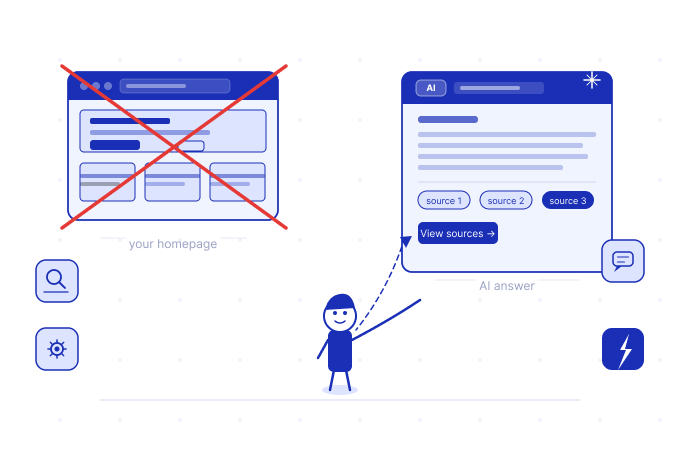
For twenty years, the homepage was sacred real estate. You spent thousands — sometimes hundreds of thousands — on its design, copy, and SEO. You obsessed over the fold, the hero image, the CTA placement. Because if someone Googled your brand name and landed there, you had them. You controlled the narrative.
That era is ending.
Today, when someone types “What is [your brand]?” or “Is [your product] worth it?” into ChatGPT, Perplexity, Gemini, or Copilot — they don’t visit your homepage. They get an answer. A synthesized, authoritative-sounding paragraph assembled from whatever those AI systems have learned about you from across the web.
You’re not in the room when that happens. And you have no control over what gets said.
The Old Funnel Is Broken
Here’s the journey that used to work: a potential customer hears about your brand, searches for it, lands on your homepage, reads your positioning, sees your social proof, and decides to convert. Every step was trackable. Every touchpoint was yours.
Now that same potential customer asks an AI assistant. The AI gives them a summary — your category, your competitors, your rough price point, and a verdict on whether you’re reputable. They may never visit your site at all. If they do, it’s to confirm a decision they’ve already made based on what the AI told them.
The homepage went from first impression to confirmation screen. And for brands that aren’t showing up well in AI answers, it’s not even getting that chance.
What Happens When AI Gets It Wrong
Here’s where it gets painful. AI models are trained on publicly available data — review sites, directories, press coverage, Reddit threads, competitor comparisons. If that data is outdated, incomplete, or dominated by a single negative source, that’s what the AI reflects back.
We’ve seen brands described as “mid-market” when they’ve repositioned upmarket. We’ve seen companies associated with features they deprecated two years ago. We’ve seen startups described as “unproven” despite thousands of case studies sitting on their website — because the AI never learned to weight that content properly.
None of this is the AI’s fault. It’s a data problem. And it’s your problem to fix.
- A brand repositioned upmarket is still described as a “budget option” in AI answers
- A SaaS tool praised in G2 reviews gets ignored because the AI weights Reddit complaints more heavily
- A company with 500 case studies shows up as “limited social proof” because AI can’t access gated content
- A local agency appears invisible on Perplexity because they’ve never been cited by a “Kingmaker Source”
AI Doesn’t Browse. It Cites.
This is the key insight most marketers miss. AI systems don’t crawl your website the way Google does. They synthesize information from a curated set of high-authority sources — what we call Kingmaker Sources. These are the publications, directories, review platforms, and industry sites that AI models have learned to trust.
If your brand appears prominently in those sources, with consistent, accurate, positive framing — you win. The AI becomes your best salesperson, describing your brand the way you want it described, at scale, 24 hours a day.
If you don’t? You’re invisible, or worse — misrepresented.
Kingmaker Sources are the high-authority third-party publications, review platforms, and industry directories that AI models consistently cite when describing brands in your category. They vary by industry — for SaaS it might be G2 and TechCrunch, for agencies it might be Clutch and Search Engine Journal. Identifying and building presence in your specific Kingmaker Sources is the single highest-leverage GEO action you can take. Learn more →
The New Brand Battlefield: Framing
When a human writes about your brand — even critically — there’s a conversation to be had. You can respond, clarify, update. When an AI describes your brand, it’s presenting a synthesis as neutral fact. There’s no byline to challenge, no editor to contact.
This means the battle for brand perception has shifted from what you publish to what gets cited. The question is no longer “What does our homepage say?” but “What does the internet’s most authoritative content say about us — and is that what AI is learning?”
| Old world (SEO era) | New world (GEO era) |
|---|---|
| Rank #1 for your brand name | Appear accurately in AI-generated brand summaries |
| Control your homepage narrative | Shape what third-party sources say about you |
| Track click-through rates | Track AI citation rates across platforms |
| Optimise for Google’s algorithm | Optimise for AI model training sources |
| One search engine to master | Four major AI platforms with different citation behaviours |
What You Can Actually Do About It
The good news: this is not a lost cause. Brands that move now — while most of their competitors are still ignoring this — have a genuine first-mover advantage. Here’s where to start.
1. Run an AI visibility audit
Before you can fix anything, you need to know what AI is currently saying about you. Test 20–30 representative prompts across ChatGPT, Perplexity, Gemini, and Copilot. Document how your brand is described, what competitors are mentioned alongside you, and whether you’re cited at all. Tools like BlueJar automate this process at scale.
2. Identify your Kingmaker Sources
Look at which sources AI platforms are citing when they describe brands in your category. These are the sites you need to prioritise for coverage, reviews, and mentions. A mention in a Kingmaker Source for your industry is worth 10x a mention elsewhere for GEO purposes.
3. Fix the factual record
If AI is describing you inaccurately — wrong pricing tier, outdated features, stale positioning — trace that back to its source. Update outdated directory listings, request corrections on review platforms, and create new authoritative content that reframes the narrative on high-trust sites.
4. Build structured, citable content
AI models love content that is clear, structured, and makes factual claims that can be independently verified. FAQ pages, comparison guides, and data-backed research posts are far more likely to be cited than brand storytelling. Create content that answers the questions AI platforms are being asked about your category.
5. Monitor consistently — not just once
AI models are retrained and updated. A brand that appears well-described today can slip in three months as new data is ingested. GEO is not a one-time project. It’s an ongoing discipline, just like SEO became.
The Homepage Isn’t Dead — But It’s No Longer First
To be clear: the homepage still matters. Once a buyer decides to explore further, it’s still where they go to confirm intent and convert. But it’s been demoted from first impression to closing argument.
The first impression is now made by AI — in a chat window, with no branding, no design, no carefully crafted hero copy. Just a paragraph. That paragraph is either working for you or against you right now. The question is whether you know which.
Most brands don’t. They’re still optimising the homepage while the real battle has moved elsewhere.
The ones who figure this out first won’t just survive the shift — they’ll define how their entire category gets described by AI for years to come. That’s a position worth fighting for.
Is AI describing your brand the way you want?
Run a free AI visibility audit with BlueJar and see exactly how ChatGPT, Perplexity, Gemini, and Copilot are representing your brand right now.