

The terminology around AI search optimization is still settling. If you’ve seen “AEO,” “GEO,” “LLMO,” “GAIO,” and “AI SEO” used interchangeably, you’re not alone. But these terms aren’t actually synonyms — they describe different scopes and origins of the same broader shift.
This guide clarifies exactly what AEO and GEO mean, where they overlap, where they diverge, and which term you should use in your strategy and client communications.
TL;DR — AEO vs GEO: What’s the Difference?
- AEO (Answer Engine Optimization) targets featured snippets and direct answers in traditional search
- GEO (Generative Engine Optimization) targets citation in AI-generated responses across platforms
- AEO is primarily Google-focused; GEO spans ChatGPT, Perplexity, Claude, Gemini, and Copilot
- GEO has superseded AEO as the broader, more accurate term for AI search optimization
- The tactics overlap significantly — but GEO adds multi-platform visibility and entity signal requirements
What Is Answer Engine Optimization (AEO)?
Answer Engine Optimization (AEO) originated in the era of featured snippets and voice search. The concept emerged around 2018-2019 as Google increasingly surfaced direct answers at the top of search results (Position Zero) and voice assistants like Alexa and Google Assistant began answering questions verbally.
AEO’s core premise: optimize your content to be the source that answer engines pull from when they provide a direct answer to a user’s question.
Original AEO tactics included:
- Structuring content to win featured snippets (Position Zero)
- Optimizing for voice search queries (conversational, question-based phrasing)
- Using FAQ format and direct question-answer content structure
- Implementing FAQ and HowTo schema markup
- Writing concise, factual answers to common questions in your domain
AEO was a prescient concept — it correctly identified that search was evolving from “find a link” to “get an answer.” But it was defined before the AI search revolution of 2023-2025 fundamentally changed what “answer engines” meant.
What Is Generative Engine Optimization (GEO)?
Generative Engine Optimization (GEO) is the practice of optimizing your website so AI-powered search engines — ChatGPT, Perplexity, Google AI Overviews, Microsoft Copilot, and others — cite, reference, and recommend your content in their generated responses.
The term was formalized in the 2024 KDD paper by Aggarwal et al. (“GEO: Generative Engine Optimization”), which provided the first rigorous, data-backed framework for optimizing content for AI search engines. Their research demonstrated that specific techniques can improve AI visibility by up to 40%.
GEO tactics include everything in AEO, plus:
- Comprehensive schema markup (Organization, Person, Article, Product — not just FAQ)
- Citation-ready content with attributed quotes and sourced statistics
- Brand entity optimization (machine-readable identity across the web)
- AI crawler access management (robots.txt for GPTBot, ClaudeBot, etc.)
- Citation tracking across multiple AI platforms
- GEO Score measurement and benchmarking
GEO is broader than AEO because it addresses the full scope of AI-powered search, not just “getting your answer into a snippet.”

AEO vs GEO: The Key Differences
| Dimension | AEO (Answer Engine Optimization) | GEO (Generative Engine Optimization) |
|---|---|---|
| Origin | Featured snippets, voice search era (2018-2019) | AI search era (2023-2024, formalized KDD 2024) |
| Target | Featured snippets, voice assistants, Knowledge Panels | ChatGPT, Perplexity, Google AI Overviews, Copilot, all AI models |
| Scope | Question-answer optimization for specific queries | Full-spectrum AI citation optimization (technical + content + authority) |
| Primary tactics | FAQ format, concise answers, FAQ schema, voice query optimization | Schema markup, cited data, entity clarity, answer-format content, AI crawler management |
| Measurement | Featured snippet wins, voice search appearances | GEO Score, AI citation frequency, AI referral traffic, mention accuracy |
| Research basis | Practitioner best practices, no formal academic framework | KDD 2024 peer-reviewed study + growing body of research |
| Industry adoption | Established but narrowing in scope | Growing rapidly; 54% of marketers planning implementation |
Where They Overlap
AEO and GEO share a significant tactical overlap, which is why they’re often confused:
Answer-Format Content
Both AEO and GEO emphasize structuring content to directly answer questions. The “question heading + concise answer + elaboration” format works for both featured snippets and AI citations.
FAQ Schema
FAQ schema (FAQPage markup) was an AEO tactic that translates directly to GEO. SEMrush’s 2025 research found that FAQ schema increases AI Overviews inclusion by 31% — validating the AEO instinct in the AI search context.
Structured Data
Both disciplines value structured data, though GEO requires a much broader schema implementation (Organization, Person, Article, Product) beyond AEO’s typical focus on FAQ and HowTo schema.
E-E-A-T Signals
Both AEO and GEO benefit from strong Experience, Expertise, Authoritativeness, and Trustworthiness signals. Expert-authored content with verifiable credentials performs well in both contexts.
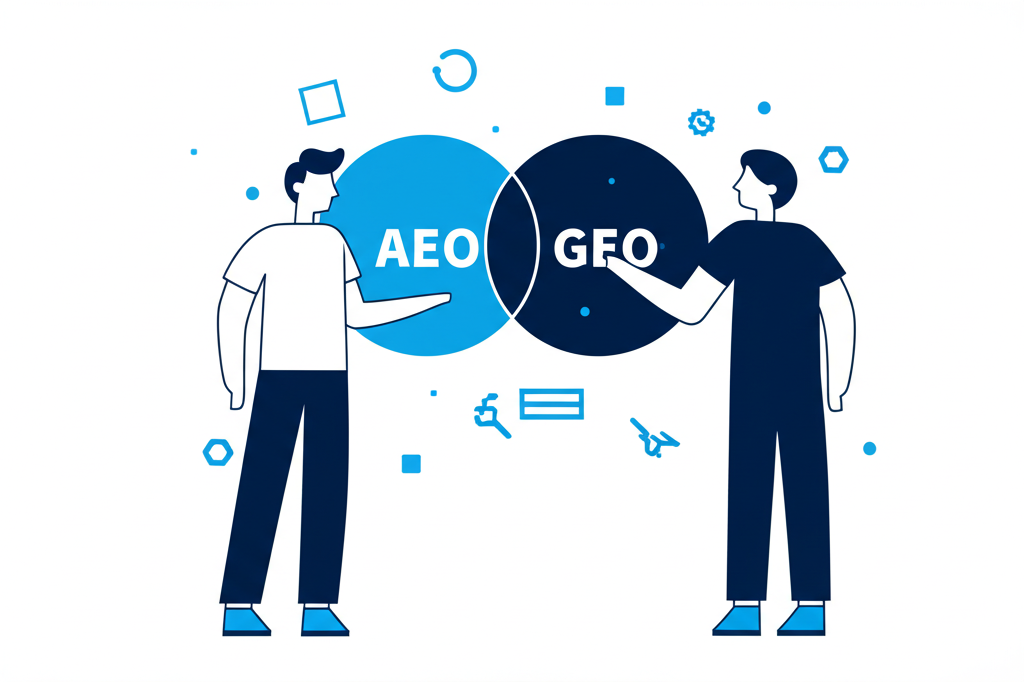
Which Term Is Winning?
The industry is converging on GEO as the primary term for AI search optimization. Several factors drive this:
- Academic legitimacy: The KDD 2024 paper gave “GEO” a formal, peer-reviewed definition. No equivalent exists for AEO.
- Broader scope: GEO covers the full spectrum of AI search optimization, while AEO’s scope is narrower (answer-focused only).
- Search volume: Google Trends shows “generative engine optimization” surpassing “answer engine optimization” in search interest since mid-2024.
- Tool ecosystem: New tools are branding around “GEO” — GEO audits, GEO scores, GEO platforms. The tooling ecosystem is standardizing on GEO terminology.
- Job market: LinkedIn job postings referencing “GEO” outnumber those referencing “AEO” by 3:1 as of early 2026.
That said, AEO isn’t disappearing. Some practitioners use it specifically for the subset of optimization focused on direct answer extraction — a narrower focus within the broader GEO framework.
Related Terms: LLMO, GAIO, AI SEO
Several other terms circulate in the AI search optimization space. Here’s how they relate to GEO:
LLMO (Large Language Model Optimization)
LLMO focuses specifically on optimizing for large language models (GPT-4, Claude, Gemini, Llama). It’s essentially GEO viewed through the lens of the AI model rather than the search interface. In practice, LLMO and GEO describe the same optimization work. GEO is the more widely adopted term.
GAIO (Generative AI Optimization)
GAIO is a variant term that some practitioners and agencies use, emphasizing the “generative AI” aspect. It covers the same territory as GEO. The term hasn’t gained as much traction because GEO was established first in the academic literature.
AI SEO
“AI SEO” is used broadly and ambiguously. It can mean: (a) using AI tools to do SEO work, (b) optimizing for AI search engines, or (c) the intersection of AI and search optimization generally. Because of this ambiguity, it’s less useful as a precise term. When someone says “AI SEO,” ask them which meaning they intend.
What Should You Call It?
Practical recommendations based on your audience:
For Agencies and Consultants
Use GEO (Generative Engine Optimization) as your primary term. It’s the most widely recognized, has academic backing, and clearly differentiates from traditional SEO. When pitching to clients unfamiliar with the term, lead with the concept (“optimizing for AI search engines like ChatGPT”) and introduce “GEO” as the industry term.
For In-House Marketing Teams
Use GEO in strategy documents and “AI search optimization” in plain-English communications with non-marketing stakeholders. Most executives understand “AI search optimization” intuitively, even if they haven’t heard of GEO specifically.
For Content and SEO Specialists
Use GEO and be prepared to explain its relationship to AEO, LLMO, and traditional SEO. Understanding the terminology landscape signals expertise to clients and colleagues.
The tools are catching up to the terminology. BlueJar’s GEO audit platform provides the measurement layer that makes GEO as actionable as SEO — with a 0-100 GEO Score, specific findings, and prioritized recommendations.
FAQ
If I’m already doing AEO, do I need to do GEO too?
If your AEO efforts focus on featured snippets and FAQ formatting, you’re partially covered. But GEO includes additional critical dimensions: comprehensive schema markup beyond FAQ, brand entity optimization, AI crawler management, cited statistics, and attribution signals. Think of AEO as a subset of GEO — you’ll want to expand your scope to cover the full GEO framework.
Can I use “AEO” and “GEO” interchangeably?
In casual conversation, most practitioners will understand what you mean either way. In formal strategy documents, proposals, and job descriptions, use “GEO” as the primary term — it’s more precise, more widely adopted, and backed by academic research.
Which term do clients respond to better?
“AI search optimization” resonates most broadly because it’s self-explanatory. “GEO” works well with marketing-savvy clients who understand the SEO parallel. “AEO” is less common in client-facing communications. Lead with the concept, then introduce the terminology.
Is GEO the final term, or will it change again?
Terminology in new fields always evolves. “GEO” has significant momentum — academic legitimacy, growing industry adoption, and a tooling ecosystem building around it. It’s the safest bet for the next 2-3 years. If the field evolves, GEO will likely broaden rather than be replaced.
Does the distinction between AEO and GEO actually matter for my optimization work?
For practical optimization, no — the tactics overlap heavily. The distinction matters for strategic framing: GEO provides a more comprehensive framework that covers technical, content, and authority dimensions. If you’re only doing AEO-style optimization (FAQ formatting and featured snippets), you’re missing the schema markup, entity clarity, and citation signal work that drive AI search visibility.
Frequently asked questions
What is AEO (Answer Engine Optimization)?
AEO (Answer Engine Optimization) is the practice of optimizing content to appear as featured snippets, voice search answers, and direct answers in traditional search engines. AEO predates GEO and focuses on structured Q&A content and featured snippet optimization in Google and Bing.
How is AEO different from GEO?
AEO targets traditional search engine answer features (Google featured snippets, voice search). GEO targets AI generative platforms (ChatGPT, Perplexity, Claude) that synthesize multi-source answers rather than pulling a single snippet. GEO is broader — it encompasses AEO while adding requirements specific to AI language models: schema markup, brand authority, factual accuracy signals.
Should I optimize for AEO or GEO first?
GEO optimization encompasses AEO — the improvements you make for AI platforms (structured content, FAQ pages, schema markup) also improve your AEO performance. If you haven’t done AEO optimization yet, start there as a foundation. GEO builds on that foundation with additional schema types, brand authority work, and citation readiness improvements.
Which is more important for business visibility in 2026?
For most businesses, GEO has a higher growth trajectory. AEO is mature — featured snippet optimization has been practiced for years and competition is fierce. GEO is earlier stage — fewer websites are GEO-optimized, making it a higher-opportunity channel for businesses that act now.