
Key Takeaways
- 83% of homeowners search online first for service providers, and 22% now use AI tools like ChatGPT instead of Google (Scorpion, 2026).
- Only 1.2% of local businesses get recommended by ChatGPT — out of 350,000 locations analyzed, the vast majority are invisible to AI search (SOCi, 2026).
- AI-referred visitors convert at 15.9% compared to just 1.76% for standard Google organic traffic — a 9x difference (Seer Interactive, 2025).
- Structured data is the key: proper LocalBusiness schema, ServiceArea markup, and FAQPage schema are what AI engines need to find and recommend your business.
- The window is open now: most home services businesses begin appearing in AI results within 30-45 days of implementing GEO optimization.
Your Next Customer Just Asked AI Instead of Google
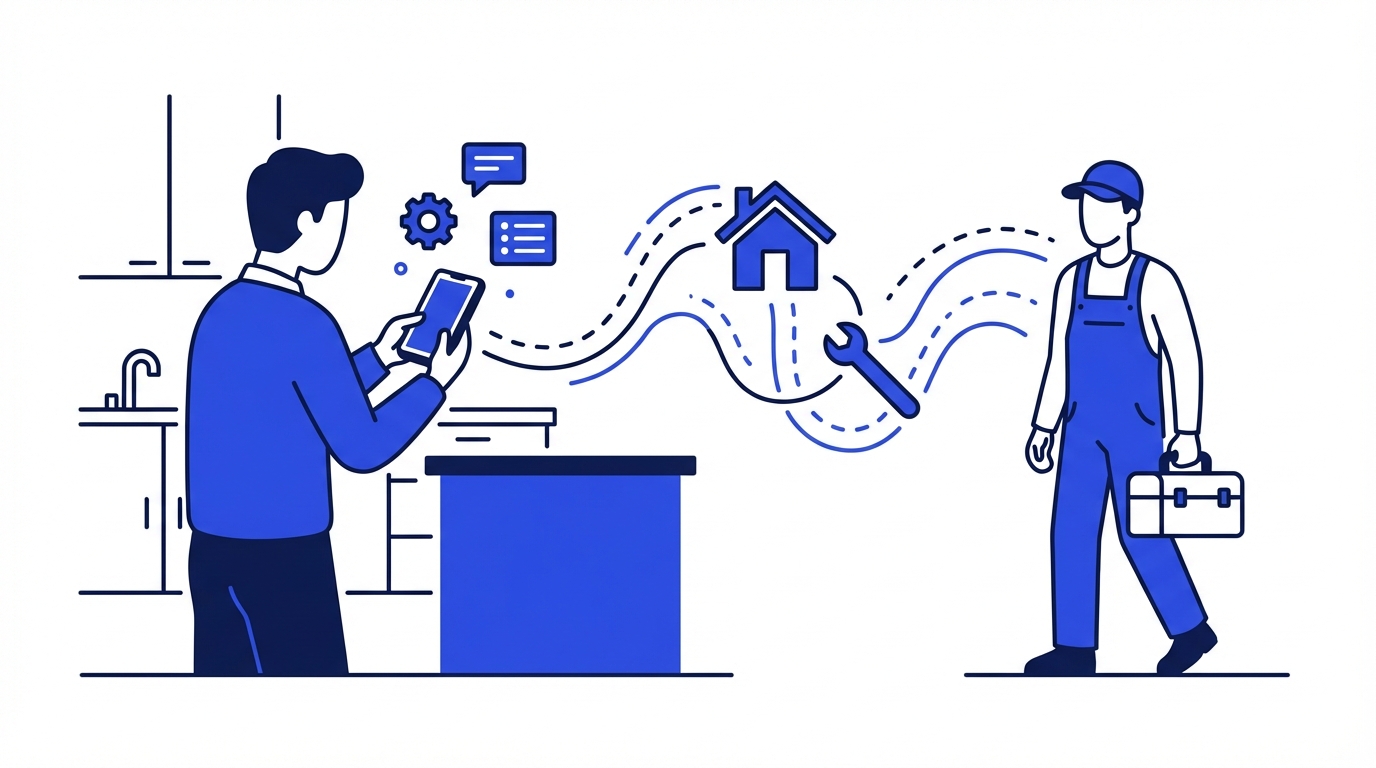
It is 10pm on a Tuesday in July. The AC unit in a three-bedroom house just stopped blowing cold air. The homeowner does not pull out the Yellow Pages. They do not even open Google. They open ChatGPT on their phone and type: “My AC stopped working and it’s 95 degrees inside. Who’s the best emergency HVAC repair company near me?”
ChatGPT names one company. One phone number. One website link.
That company gets the call. Everyone else gets nothing — not a lower ranking, not a second-page listing. Just silence.
This is not a hypothetical scenario. This is how a growing number of homeowners find service providers right now. According to Scorpion’s 2026 State of Home Services Marketing Report, which surveyed 2,000 U.S. homeowners who had hired a trades professional in the past 18 months, 83% of homeowners start their search for a service provider online (Scorpion, 2026). That number alone is not new. What is new: 22% of those homeowners now use AI tools like ChatGPT to research or find recommendations (Scorpion, 2026).
Think about that. More than one in five of your potential customers is asking an AI chatbot — not Google, not Yelp, not Angi — to tell them who to hire. And that number is climbing fast. Six months ago, it was closer to 10%. A year from now, it could be 35% or higher. This is the same adoption curve that Google Maps and smartphones followed — slow at first, then suddenly everyone is using it and the holdouts are the ones wondering where their leads went.
The way people search has changed, too. The old search query was short and mechanical: “plumber tampa fl” or “HVAC repair 33606.” The new query is conversational and detailed: “Why won’t my toilet stop running and how much will it cost to fix?” (WebFX, 2025). Younger homeowners especially — Gen Z averages 5.83 words per search, and 43.57% of their searches are phrased as full questions compared to just 23.22% for Baby Boomers (WebFX, 2025).
This shift is accelerating. Gartner predicted that traditional search engine volume would drop 25% by 2026 due to AI chatbots and virtual agents (Gartner, 2024). Whether the drop hits exactly 25% or not, the direction is clear: the search box is losing ground to the chat window.
If your business is built entirely around Google rankings and paid ads, the ground is shifting under your feet. The question is not whether AI search matters for home services. It is whether you will be the company AI recommends — or the one it skips.
Why AI Can’t Find Your Business
Here is the uncomfortable reality. Even if you have great Google reviews, a solid website, and years of experience, AI probably does not know you exist.
SOCi’s 2026 Local Visibility Index analyzed more than 350,000 business locations across 2,751 enterprise brands. The finding that should worry every home services business owner: ChatGPT recommended only 1.2% of those locations (SOCi, 2026).
Let that sink in. Out of 350,000 locations, ChatGPT pointed customers to roughly 4,200 of them. The rest were invisible.
For comparison, businesses appeared in Google’s local 3-pack 35.9% of the time (SOCi, 2026). That means getting recommended by ChatGPT is approximately 30 times harder than showing up in Google’s top local results (Search Engine Land, 2026).
And here is the part that catches most business owners off guard: being good at Google does not mean you will be good at AI. SOCi found only 45% overlap between the brands leading in traditional local search and those leading in AI search (SOCi, 2026). More than half of the businesses dominating Google are invisible to ChatGPT, and vice versa. These are two different games with different rules.
| Factor | Traditional Google Search | AI Search (ChatGPT, Gemini, Perplexity) |
|---|---|---|
| How You Appear | Ranked list — position 1 through 10+ on each page | Selected or excluded — AI names 1-3 businesses, everyone else is invisible |
| Cost Model | Pay-per-click ($7-$14/click for home services) | Free — AI citations cost nothing per referral |
| Conversion Rate | 1.76% from organic search traffic | 15.9% from AI referral traffic (9x higher) |
| Trust Signal | Star ratings, review count, ad badges | Structured data, content depth, schema markup, 4.3+ star threshold |
| Geographic Targeting | Google Business Profile location + proximity | ServiceArea schema with explicit city/zip code declarations |
So why can’t AI find your plumbing company, HVAC business, or roofing operation? Three specific reasons:
1. Missing LocalBusiness Subtype Schema
Most home services websites either have no structured data at all or use generic “LocalBusiness” schema. AI models rely heavily on schema markup to understand what your business actually does. There are specific schema types built for your trade — Plumber, HVACBusiness, Electrician, RoofingContractor — and if your website does not use them, AI has to guess. AI does not like guessing. It moves on to a business that makes things explicit.
2. No ServiceArea Schema
You might serve a 50-mile radius around your shop. You might cover three counties. But if your website does not declare that with ServiceArea schema — including specific city names, zip codes, or geographic regions — AI has no reliable way to know where you work. When a homeowner in your territory asks ChatGPT for a recommendation, your business does not come up because the AI literally cannot confirm you serve that area.
3. Reviews Are Not Bridged to Your Website
You might have 400 five-star reviews on Google and another 150 on Yelp. That is great for Google search. But AI models do not just scrape Google Maps results — they synthesize information from multiple sources including your actual website. If your website does not include AggregateRating schema that reflects your review data, AI sees a website with no social proof. The reviews exist, but they are locked in Google and Yelp silos that AI cannot always access or trust in the same way.
The common thread: AI needs structured, machine-readable signals on your website. A beautiful website with customer testimonials embedded as images or screenshots does not help. AI reads code and structured data, not JPEGs.
What AI Recommends (And Why)
Understanding what makes AI choose one business over another is the key to getting in front of these customers.
SOCi’s research revealed that locations recommended by ChatGPT averaged 4.3-star ratings (SOCi, 2026). That lines up directly with homeowner expectations: according to Scorpion’s survey, 87% of homeowners will not hire a business rated below 4 stars (Scorpion, 2026).
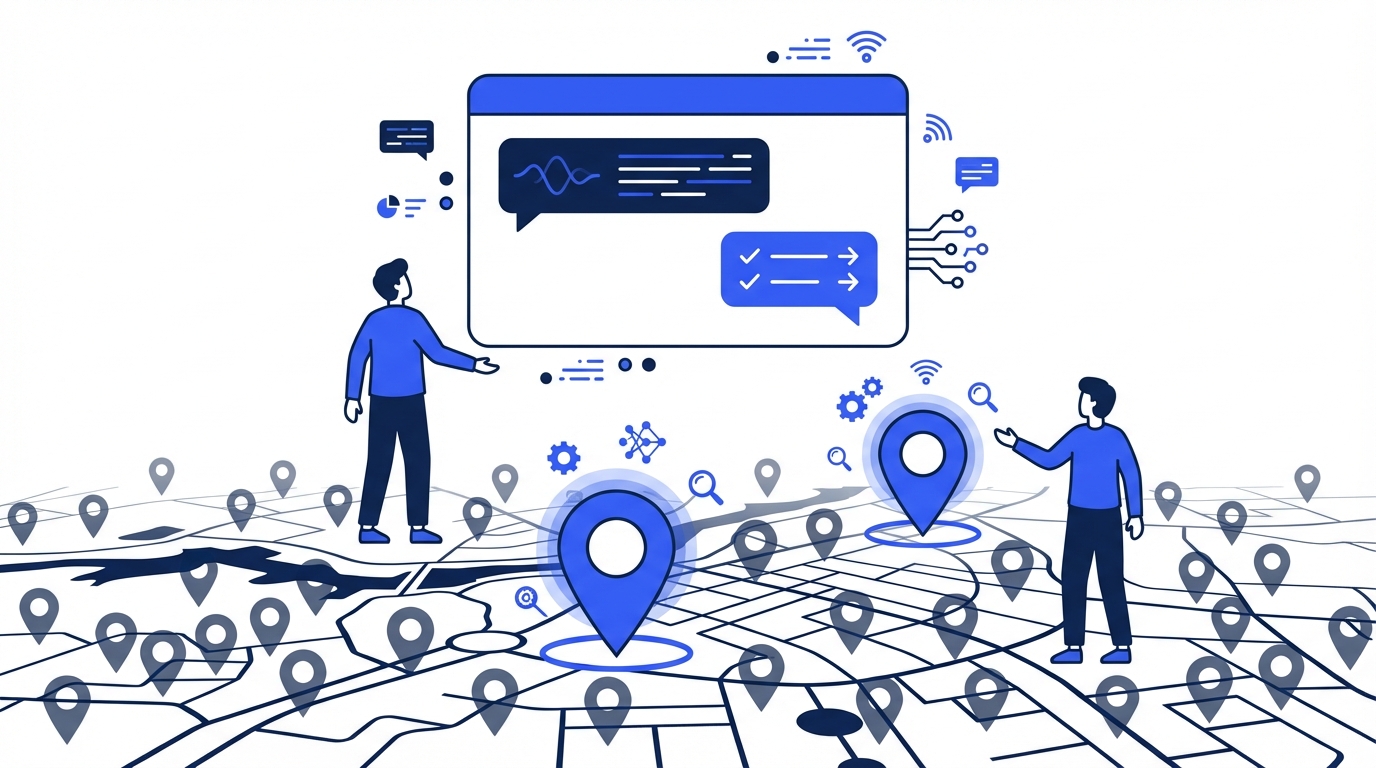
But here is the important distinction. Google ranks businesses — it creates a numbered list from first to last. AI does not rank. AI selects. It uses what you could call threshold logic: the AI looks for businesses that clear a quality bar across multiple signals, then recommends the ones that clear it most convincingly. If your business falls below that bar on any major signal — ratings, content quality, structured data, geographic relevance — you do not get a lower position. You get excluded entirely.
This means AI recommendations work more like a pass/fail exam than a class ranking. There is no “page two” of ChatGPT results. You are either in or out.
“In an environment where AI often returns a single answer, being visible means being chosen.”— Monica Ho, CMO, SOCi
Think of it this way: on Google, being result number 7 still gets you some traffic. Maybe not a lot, but some. In AI search, there is no result number 7. The AI names one, maybe two or three businesses. If you are not one of them, you are not in the conversation at all. The homeowner never sees your name, never visits your site, and never knows you exist.
The Content That Gets Cited
AI models prioritize certain types of content when making recommendations for service providers:
Educational content about your services. A page that explains what a sewer line inspection involves, when it is needed, and what the process looks like gives AI substantive content to reference. A page that just says “We do sewer line inspections — call now!” does not.
Pricing guides with ranges. Homeowners ask AI “how much does it cost to replace a water heater?” If your website has a page answering that question with real price ranges for your market, AI has something to cite. If you hide all pricing, AI cites someone who does not.
Troubleshooting Q&As. Remember, search queries are becoming conversational. Homeowners are asking AI questions like “Why is my furnace blowing cold air?” and “Is it normal for my electric bill to double in winter?” The businesses that publish clear, helpful answers to these questions become the sources AI draws from.
Before-and-after case studies. Content that describes a real job — what the problem was, how you diagnosed it, what the fix involved, and what it cost — is exactly the kind of specific, authoritative content that AI models weight heavily. It demonstrates expertise in a way that a generic “About Us” page never can.
Your Competitors Are Already Adapting
If you think AI is a future concern, consider this: approximately 70% of small and mid-sized businesses already use AI in their day-to-day operations (U.S. Chamber of Commerce, 2026) — for scheduling, invoicing, customer communication, and marketing. Your competitors are not waiting. The ones investing in AI visibility now are building a moat that will be harder to cross later.
The 5-Step GEO Fix for Home Services
GEO stands for Generative Engine Optimization — making your business visible to AI search tools like ChatGPT, Google Gemini, Perplexity, and Microsoft Copilot. Here is the practical playbook for home services businesses.
Step 1: Add the Correct LocalBusiness Subtype Schema
Do not use generic “LocalBusiness” schema. Use the specific subtype that matches your trade:
- Plumbers:
Plumberschema type - HVAC companies:
HVACBusinessschema type - Electricians:
Electricianschema type - Roofers:
RoofingContractorschema type
Within that schema, include your GeoCoordinates (latitude and longitude of your business location) and ServiceArea with every city, county, or zip code you serve. This tells AI exactly what you do and exactly where you do it. No ambiguity.
If you serve multiple trades — say you are a general contractor who does plumbing, electrical, and HVAC — use the HomeAndConstructionBusiness parent type and list each specialty as an additionalType.
Step 2: Create Problem-Solving Content
Build out pages and blog posts that answer the actual questions homeowners are asking AI. Not keyword-stuffed landing pages. Real, helpful content.
Examples:
– “Why Is My Water Heater Making a Popping Noise? (And When to Call a Pro)”
– “AC Running But Not Cooling: 7 Causes and What Each Repair Costs”
– “How to Tell If You Need a Roof Repair or a Full Replacement”
Each piece should include what the problem is, what causes it, whether it is a DIY fix or a professional job, and what the approximate cost range is in your market. This is the content format AI models cite most frequently because it directly answers the questions users are asking.
Aim for 800-1,500 words per article. You do not need to publish every day. Two to four solid, detailed posts per month will outperform a dozen thin pages. Quality and depth are what AI rewards — not publishing frequency.
Step 3: Bridge Your Review Signals
Add AggregateRating schema to your website that reflects your actual review data. This means including:
- Your average star rating
- The total number of reviews
- The best and worst ratings
This does not mean faking reviews or inflating numbers. It means taking the real review data that already exists on Google, Yelp, and other platforms and making it machine-readable on your own website. Many review management plugins and widgets do this automatically — just make sure the schema markup is actually in the page source, not just rendered visually.
Step 4: Add Service Schema with Pricing
For each service you offer, add Service schema markup that includes:
- The service name (e.g., “Water Heater Installation”)
- A description of what is included
- The service area
- A price range or starting price using
priceRangeoroffers
AI models want to give users specific, useful answers. When a homeowner asks “how much does it cost to replace a garbage disposal in Phoenix?”, AI will prefer businesses that provide structured pricing data over those that do not.
You do not need to list exact prices if your costs vary by job. A range works fine — for example, “Garbage disposal replacement: $150-$400 depending on unit and installation complexity.” The goal is giving AI something concrete to work with rather than a blank page or a “call for a quote” dead end.
Step 5: Build FAQPage Schema with Real Customer Questions
Take the 10-20 questions your office gets asked most often on the phone. Turn them into a FAQ page with proper FAQPage schema markup. Questions like:
- “Do you charge for estimates?”
- “How quickly can you come out for an emergency?”
- “Do you offer financing?”
- “Are you licensed and insured?”
- “What brands of equipment do you install?”
This schema format is specifically designed for AI consumption. Google already uses it for featured snippets and AI Overviews. ChatGPT and other AI tools pull from it heavily when answering local service questions.
One important note: do not just make up questions that sound good for SEO. Use the real questions your team hears every day. The authenticity matters because those are the exact same questions homeowners are typing into ChatGPT. When the question on your FAQ page matches the question in the AI prompt word-for-word, you have a direct path to being cited.

The Opportunity Is Now
The home services market is enormous and growing. The U.S. home services industry represents an estimated $650 billion in serviceable industry spend, with more than $300 billion in deferred maintenance backlog from homeowners who put off repairs during recent economic uncertainty (ServiceTitan, 2025). That deferred work is coming due. The question is which businesses will capture it.
Here is why AI visibility matters for that capture:
AI traffic converts at dramatically higher rates. Visitors who arrive at your website through a ChatGPT recommendation convert at 15.9%, compared to just 1.76% for standard Google organic traffic (Seer Interactive, 2025). That is a 9x difference. The reason is straightforward — by the time someone clicks through from an AI recommendation, they have already done their research inside the AI conversation. They are not browsing. They are ready to book.
Results come fast. Unlike traditional SEO, which can take 6-12 months to show meaningful results, most businesses begin appearing in AI search engine results within 30-45 days of implementing local AI search optimization (Digital Shift, 2026). Strong positioning across multiple AI search engines typically happens within 60-90 days. For a business that needs leads now, not next year, that timeline matters.
Speed to respond is the deciding factor. According to industry data, 78% of customers hire the first contractor who responds (Demand Local, 2025). If AI names your business and a homeowner calls you, and you pick up — you win the job. Pair AI visibility with fast response and you have a system that consistently generates booked work.
Homeowner expectations are rising. Scorpion’s survey found that 56% of homeowners want 24/7 scheduling or a way to communicate after hours (Scorpion, 2026), and 87% will not hire below 4 stars (Scorpion, 2026). Businesses that invest in both their online reputation and their responsiveness are the ones AI will recommend — because AI weighs exactly those factors.
The window is open right now. Only 1.2% of local businesses are getting recommended by ChatGPT. The businesses that invest in GEO today — proper schema, helpful content, bridged reviews — will own AI search results in their markets before their competitors even realize the game has changed.
Here is the math that should motivate you. If you are a plumber who serves a metro area with 200 plumbing companies, and ChatGPT is currently recommending roughly 1.2% of businesses, that means maybe 2-3 plumbers in your entire market are getting AI referrals right now. If you become one of them, you are not competing against 199 other companies for that customer. You are competing against 2. And those AI-referred customers convert at 9x the rate of organic traffic. That is a competitive advantage most businesses would pay a fortune for — and right now, it is available to anyone willing to put in the structured data work.
The trades have always rewarded the people who show up first and do the work right. AI search is no different. Show up. Make it easy for AI to find you. And be ready when the phone rings.
Frequently Asked Questions
Why can’t ChatGPT find my home services business?
ChatGPT recommends only 1.2% of business locations according to SOCi’s 2026 Local Visibility Index. The main reasons home services businesses are invisible: missing or incomplete LocalBusiness schema markup, no ServiceArea structured data telling AI where you operate, thin or generic service descriptions that don’t answer specific homeowner questions, and low review volume or ratings below the 4.3-star threshold AI engines prefer.
What schema markup do home services businesses need?
At minimum: LocalBusiness schema (with your specific trade type like Plumber, Electrician, or HVACBusiness), ServiceArea markup listing the cities and zip codes you serve, FAQPage schema on your FAQ and service pages, and AggregateRating with your review data. These structured data elements tell AI engines exactly what you do, where you do it, and how well you do it — the three factors they use to generate recommendations.
How much does GEO optimization cost for a home services company?
A typical GEO audit runs $500-$1,000 for a single-location business. Full implementation — including schema deployment, content creation, and review strategy — ranges from $1,500 to $4,000 depending on the size of your site and number of service pages. Ongoing monitoring runs $300-$1,000 per month. Compare that to Google Ads where you’re paying $7.85-$13.74 per click — AI citations deliver leads at zero marginal cost.
Will optimizing for AI search hurt my existing Google rankings?
No — GEO optimization actually strengthens your traditional SEO. The content you create for AI visibility (problem-solving articles, FAQ pages, structured data) also improves your Google rankings. The schema markup helps Google understand your site better, and the informational content targets long-tail queries that drive additional organic traffic. You get double value from a single investment.
Run your free GEO audit at bluejar.ai — see exactly how visible your business is to ChatGPT, Google Gemini, and Perplexity, and get a step-by-step fix list in under 5 minutes.