
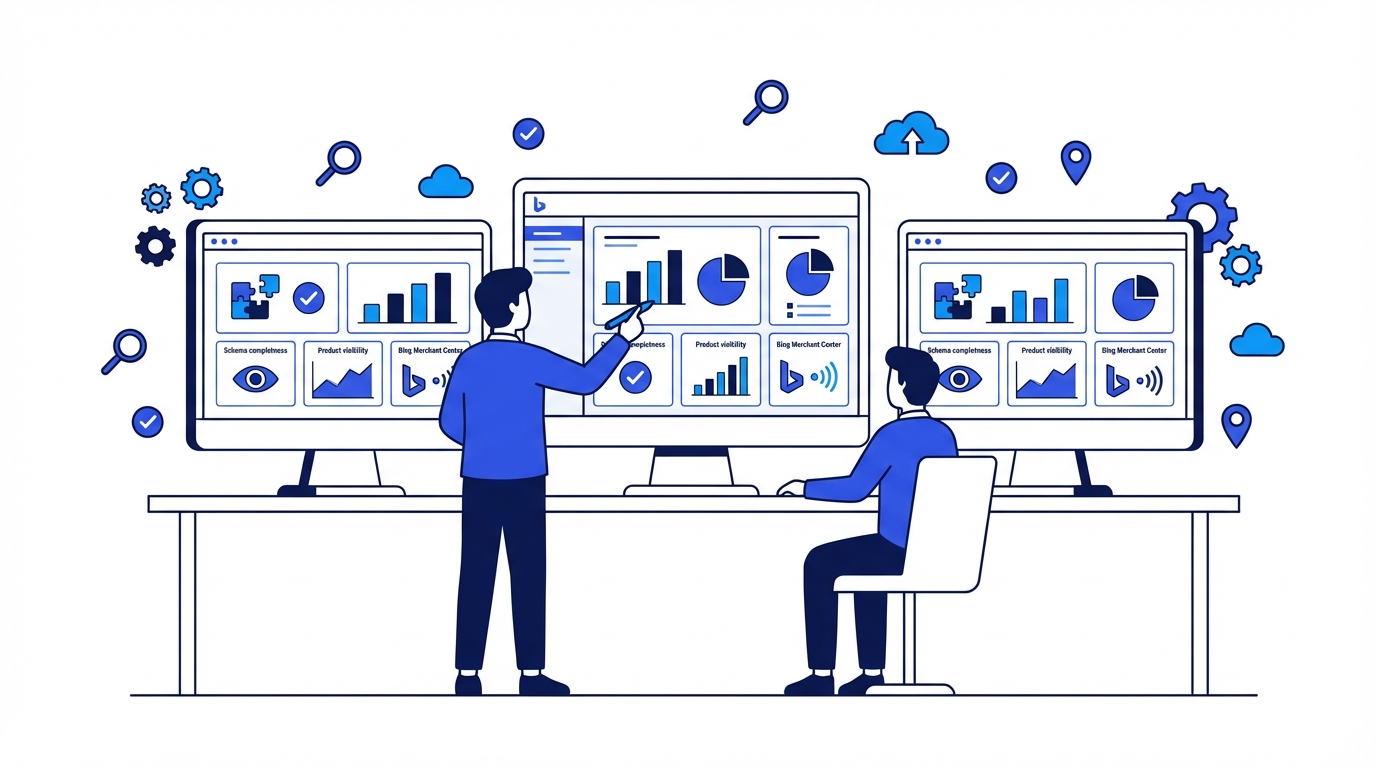
Key Takeaways
- ChatGPT checkout is live for 1M+ Shopify stores — but being on Shopify doesn’t mean AI will recommend your clients’ products.
- 64% of consumers plan to use AI chatbots for shopping in 2026, up from under 20% in 2024 (Capital One Shopping, 2025).
- Only 36% of e-commerce sites have valid, complete schema markup — most Shopify stores have structural gaps AI engines can’t parse.
- Three-tier GEO service package: Audit ($500-$1,500), Implementation ($2,000-$6,000), and Monitoring ($500-$2,000/mo) for Shopify-specific AI optimization.
- 73% of marketers plan to increase conversational commerce investment by up to 50% by 2027 — your clients’ competitors are already planning to invest.
ChatGPT Is Now a Shopping Cart — And Your Clients Aren’t In It
In February 2026, OpenAI rolled out native checkout inside ChatGPT. Not a link to a product page. Not a “learn more” redirect. An actual “Buy it in ChatGPT” button that lets users complete a purchase without ever leaving the conversation (OpenAI, 2026). Perplexity did the same thing weeks earlier, integrating PayPal one-click checkout directly into AI-generated shopping answers (Perplexity, 2025). Google’s AI Overviews have been surfacing product carousels with pricing and availability for months.
This is not a research tool anymore. AI is a transactional channel. And if your Shopify clients’ products are not showing up in these AI-generated shopping experiences, they are being cut out of a rapidly growing revenue stream.
The consumer intent is already there. A Capital One Shopping study found that 64% of consumers plan to use AI tools for shopping decisions (Capital One Shopping, 2025). That is not a niche early-adopter segment — it is the majority of online shoppers signaling that their buying behavior is shifting toward AI-first discovery.
The traffic numbers confirm it. AI-driven e-commerce traffic in the US grew 758% year-over-year between November and December 2025 (eMarketer, 2025). That is not a typo. Nearly eight times more shoppers came through AI channels compared to the same period in 2024. The holiday season was the inflection point, and the trajectory has only accelerated since.
Amazon saw it coming and moved first. Their AI shopping assistant Rufus now appears in 38% of all shopping sessions on the platform, and shoppers who use Rufus are 60% more likely to complete a purchase (Amazon, 2025). Amazon is proving what every e-commerce operator should already understand: when you embed AI into the shopping experience, conversion rates climb. The question for your Shopify clients is whether they will be part of that AI-mediated shopping flow or shut out of it entirely.
“Shopping is changing fast. People are discovering products in AI conversations, not just through search or ads. The stores and agencies that adapt their content and structured data for this shift will capture the next wave of e-commerce growth.”
— Vanessa Lee, VP of Product, Shopify
This shift is not theoretical. It is not a 2028 prediction from a Gartner report. ChatGPT has a “Buy” button today. Perplexity has a checkout flow today. Your clients’ competitors are getting cited in AI shopping results today. Every week your Shopify stores stay invisible to AI is a week of lost revenue you cannot recover.
The agencies managing Shopify stores have a decision: treat this as someone else’s problem, or build a GEO service offering that solves it. The opportunity is not just for your clients — it is for your agency’s top line.
The Shopify-Specific Problems Your Clients Have
Shopify is arguably the best e-commerce platform for launching and scaling a store. But when it comes to AI visibility, it has structural blind spots that most agencies are not addressing — because they were never problems for traditional SEO.
Schema Markup Is Broken or Missing
According to Go Fish Digital’s research on schema implementation across e-commerce sites, only 36% of websites have valid, complete schema markup (Go Fish Digital, 2025). That means roughly two-thirds of your Shopify client stores are running with schema that is either missing critical fields, malformed, or absent entirely.
Shopify’s default themes do ship with basic Product schema. But “basic” is the operative word. Out of the box, most Shopify themes provide the bare minimum — name, price, availability, and sometimes an image URL. What they consistently miss is the structured data that AI engines actually prioritize when deciding which products to cite:
- AggregateRating: Review scores and review count. AI engines heavily weight social proof when recommending products. Without AggregateRating in your schema, your client’s 4.8-star rating from 2,000 reviews is invisible to AI.
- Brand: The Brand property is either omitted entirely or not properly nested as an Organization or Brand entity. When ChatGPT is asked “What’s the best [brand] product for [use case]?”, schema Brand data is how it connects your client’s product to the query.
- Complete Offer details: Price, priceCurrency, availability, and priceValidUntil are often incomplete. Shopify themes frequently omit seller information, shipping details, and return policies from the Offer schema — all fields that AI engines use to evaluate purchase trustworthiness.
Third-Party App Schema Conflicts
This is the one that blindsides agencies. Your Shopify client installs a reviews app like Judge.me or Loox, a rich snippets app like JSON-LD for SEO, and maybe a product recommendations app. Each one injects its own schema markup. The result is competing JSON-LD blocks on the same page — sometimes two or three Product schema blocks with conflicting data.
Google’s Rich Results Test might not flag this as an error, but AI engines parsing the page see contradictory signals. Two different review counts. Conflicting availability statuses. Mismatched pricing. For an AI engine trying to decide whether to cite this product, conflicting schema is a disqualifying signal. It undermines trust.
The fix requires auditing every installed app’s schema output, removing redundant markup, and consolidating into a single authoritative JSON-LD block — usually by editing the theme’s Liquid templates directly.
Collection Pages and Blogs Are GEO Dead Zones
Shopify collection pages are the workhorses of store navigation, but they ship with zero structured data by default. No CollectionPage schema, no ItemList markup connecting the collection to its products, no BreadcrumbList for navigation context. From an AI engine’s perspective, a collection page is an undifferentiated list of links with no semantic meaning.
Shopify blogs are even worse. Most stores either do not use the blog feature at all, or populate it with thin content that has no Article schema, no author markup, and no FAQ or HowTo structured data. Yet blogs are where your clients should be building the informational content that AI engines love to cite — buying guides, comparison articles, how-to content. The blog infrastructure exists in Shopify. The GEO optimization layer does not.
Product Descriptions Are Thin
Here is the content problem underneath the schema problem. Most Shopify product descriptions are 50 to 150 words of feature bullets and a paragraph of sales copy. That is not enough for an AI engine to extract meaningful buying guidance from.
When ChatGPT answers “What’s the best yoga mat for hot yoga?”, it cites sources that explain materials, grip performance in humid conditions, thickness tradeoffs, cleaning requirements, and durability comparisons. A product page that says “Premium non-slip yoga mat, 6mm thick, available in 5 colors” gives AI nothing to work with. The product might be perfect for hot yoga, but the content does not say so in a way AI can parse and cite.
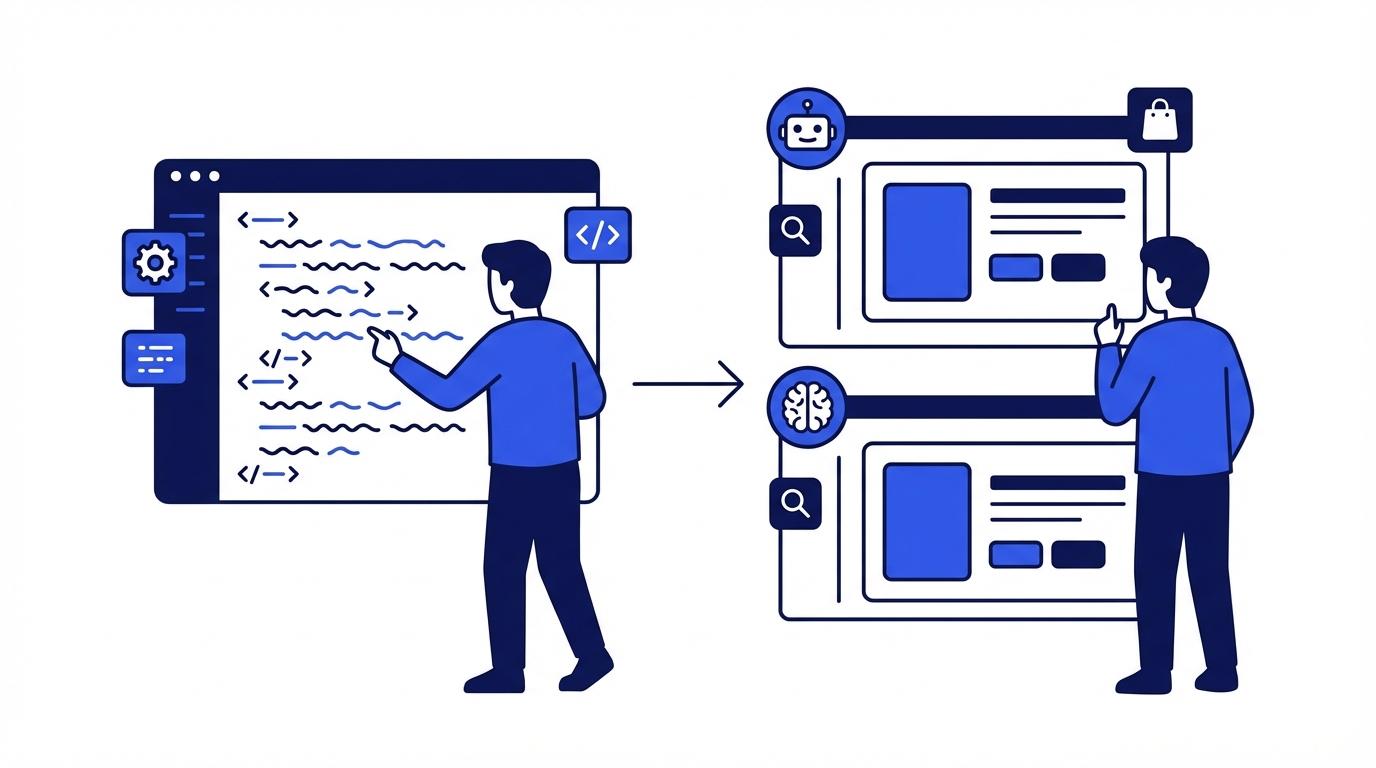
The GEO Service Package for Shopify Clients
You do not need to build a new agency to sell GEO services. You need three tiers that layer on top of what you are already doing for Shopify clients. These are incremental revenue on existing retainers, not replacement services.
Audit Tier: $500 – $1,500
This is your entry point. A one-time GEO audit that gives the client a clear picture of where they stand in AI search. The deliverable is a report covering:
- Product schema completeness score: Crawl every product page and score the schema against a complete Product schema specification. Check for AggregateRating, Brand, Offer with all subfields (priceCurrency, priceValidUntil, seller, shippingDetails, hasMerchantReturnPolicy), Review markup, and image properties. Most Shopify stores score below 40% completeness.
- App schema conflict audit: Identify every installed app that injects JSON-LD and document the conflicts. Map which apps are generating redundant or contradictory markup. This alone is worth the audit fee — most store owners have no idea their apps are fighting each other.
- Bing Merchant Center status check: Many Shopify agencies focus exclusively on Google. But Bing’s product feeds power a significant portion of AI shopping results, including Perplexity’s product recommendations. Check whether the client’s store is connected to Bing Merchant Center, whether the feed is active and error-free, and whether product data is flowing correctly.
- Content depth score: Evaluate product descriptions, collection page content, and blog content against the depth thresholds that correlate with AI citations. Products with fewer than 300 words of substantive content get flagged. Collections with no descriptive text get flagged. Blog posts under 1,000 words with no structured data get flagged.
- AI citation test: Run the client’s top 20 product-category queries through ChatGPT, Perplexity, and Google AI Overviews. Document who gets cited, who gets recommended, and where the client is absent.
Price based on catalog size. A store with 50 products gets the $500 audit. A store with 500+ products and multiple collections is $1,500. The work is heavily tool-assisted — BlueJar handles the GEO scoring and schema analysis, and you layer your Shopify expertise on top.
Implementation Tier: $2,000 – $6,000
Once the audit surfaces the gaps, the implementation scope is clear. This is a project engagement — typically 4 to 8 weeks depending on store complexity.
- Liquid template schema fixes: Edit the client’s theme Liquid files directly —
product.liquid,collection.liquid,article.liquid, andtheme.liquid— to implement complete, conflict-free JSON-LD. Remove app-generated duplicate schema. Build dynamic schema that pulls from Shopify’s product metafields so that as product data changes, the schema stays accurate. This eliminates schema drift at the source. - Product description enrichment: Rewrite thin product descriptions to meet the 300+ word threshold with substantive content. This is not fluff — it is material-specific details, use-case guidance, comparison context, sizing and fit information, and care instructions. Structure descriptions with headers so AI engines can parse individual sections. For a store with 200 products, this is typically the largest line item in the implementation scope.
- Collection page optimization: Add CollectionPage and ItemList schema to collection templates. Write 200-400 word introductions for each major collection that explain the category, buying considerations, and what differentiates the products within it. This turns GEO dead zones into citable content.
- Bing Merchant Center integration: Connect the store to Bing Merchant Center if it is not already. Configure the product feed, resolve any data quality errors, and verify products are indexed. This is a one-time setup that pays dividends across every AI engine that pulls from Bing’s product graph.
- Blog content strategy launch: Publish 5-10 foundational blog posts with full Article schema, author markup, and FAQ structured data. Target informational queries in the client’s niche — buying guides, comparison posts, how-to content. These are the pages that AI engines will cite when answering shopping research questions.
Ongoing Monitoring: $500 – $2,000/month
This is your recurring revenue. AI search results are volatile — what gets cited this week might not get cited next month. The monthly retainer covers:
- AI citation monitoring: Track the client’s product and brand mentions across ChatGPT, Perplexity, Google AI Overviews, and Bing Chat on a weekly cadence. Report citation frequency, sentiment, and competitive positioning.
- Competitor citation tracking: Monitor 3-5 direct competitors’ AI visibility. When a competitor starts getting cited for a query the client should own, flag it and respond with content or schema improvements.
- New product optimization: As the client adds products, ensure each one launches with complete schema, substantive descriptions, and appropriate internal linking. This prevents the schema and content gaps from reopening.
- Content refresh and expansion: Publish 2-4 new blog posts per month targeting emerging AI shopping queries. Update existing content to keep it current. AI engines favor recently updated content — a buying guide from six months ago will lose citations to one updated this week.
- Monthly reporting: Deliver a clear dashboard showing GEO score trends, citation counts by AI platform, top-cited products, and recommendations for the next month.
The key positioning for all three tiers: this is incremental revenue on top of existing Shopify agency retainers. You are not replacing their SEO, their paid ads, or their email marketing. You are adding a new service line that addresses a channel none of those existing services cover.
| Revenue Metric | Google Ads (CPC) | AI Citation Traffic |
|---|---|---|
| Cost Per Click | $1.50–$4.00 (rising quarterly) | $0 (zero marginal cost) |
| Conversion Rate | 2.5–3.5% avg e-commerce | 31% higher than non-branded organic |
| Annual Traffic Growth | Flat to declining (AI Overviews cannibalizing) | 4,700% YoY for shopping queries |
| Buyer Intent | Mixed (broad + exact match) | High (specific product questions) |
| Competition | Bidding wars, rising CPCs | Wide open — most stores not optimized |
| Setup Effort | Ongoing campaign management | One-time schema + content optimization |
Making the Case to Clients
You have the service packages built. Now you need to get the client to say yes. Shopify store owners are practical — they want data, they want proof, and they want to understand the ROI before they commit. Here is how to structure the conversation.
Lead With the Headline
Open with this: “ChatGPT is now a shopping cart. There are over 1 million active Shopify stores. When a shopper asks ChatGPT ‘What’s the best [product] for [use case]?’, does your store show up?” That framing immediately makes it concrete. The client is not evaluating an abstract technology trend. They are evaluating whether they are visible in a channel where their customers are already shopping.
Show AI Overviews Eating Product Queries
Google’s AI Overviews are now appearing on transactional product queries at a rapidly growing rate — transactional AI Overviews increased 600% in 2025 compared to early rollout levels (DesignRush, 2025). This means that even on Google, the traditional “10 blue links” are being displaced by AI-generated answers for shopping queries. Your client’s Google Ads and organic rankings are competing with an AI summary box that may or may not include their products.
Pull up a specific product query in the client’s niche during the conversation. Show them the AI Overview. Show them which brands are cited and which are not. If their competitor is in the AI Overview and they are not, the visual impact is immediate.
Run a Live BlueJar Audit
Nothing sells GEO services faster than showing the gaps in real time. Run a BlueJar GEO audit on the client’s store during the meeting. Show them the schema completeness score — when they see that their product pages are missing AggregateRating, Brand, and half the Offer fields, they understand the problem immediately. Then run the same audit on their top competitor. If the competitor scores higher, the competitive urgency writes the proposal for you.
Make the ROI Comparison
Your Shopify clients are spending money on Google Ads and Meta Ads to drive product discovery. Pull their average CPC for their top product categories. For many e-commerce niches, that is $1.50 to $4.00 per click, and rising every quarter. Now compare that to AI citations — which drive traffic at zero marginal cost per click.
If a product gets cited by ChatGPT in response to 1,000 shopping queries per month, and even 10% of those users click through to the store, that is 100 visits that would have cost $150 to $400 through paid ads. Multiply that across a product catalog and the annual value of AI visibility compounds quickly. It does not replace paid ads, but it creates a channel with dramatically better unit economics.
Reference the Broader Market Shift
For clients who need the macro context before committing, use this: 73% of marketers plan to increase their investment in conversational commerce by up to 50% by 2027 (Smartly, 2025). Conversational commerce is the industry term for AI-mediated shopping — exactly what ChatGPT checkout and Perplexity’s Buy With Pro represent. Your client’s competitors are planning to increase spend in this channel. The question is whether your client will invest now, when the field is open, or later, when the competition is entrenched.
Handle the Objection
The objection you will hear from Shopify store owners: “We already rank well on Google. Our ads are working.” The response: “Your Google rankings and ads bring people to your store. But 64% of shoppers plan to use AI for purchase decisions (Capital One Shopping, 2025). AI search is a different channel with different rules. Your Google rankings do not carry over. You need to be visible in both — and right now, you are only visible in one.”
Position GEO as additive. It does not compete with existing channels. It covers the gap that SEO and paid ads cannot reach.
Get Started
You do not need to overhaul your agency to start selling GEO services to Shopify clients. You need three actions this week.
1. Audit Your Top 3 Shopify Client Stores
Run a GEO audit on your three largest or most engaged Shopify clients. Use BlueJar’s free tier — you get 5 audits, which is enough to cover your top accounts with room for a competitor comparison. Look at schema completeness, content depth scores, and which AI platforms are currently citing (or ignoring) their products.
Pay special attention to the Shopify-specific issues: app-generated schema conflicts, missing AggregateRating, thin product descriptions, and empty collection page content. These are the gaps that will be most tangible to the client because they map to things the client can see and understand in their own store admin.
2. Check Their Bing Merchant Center Status
Log into each client’s Bing Merchant Center account — or check whether one exists. A surprising number of Shopify agencies have never connected their clients to Bing’s product ecosystem. Given that Bing’s product data feeds into multiple AI engines, this is a quick win with outsized impact. If the feed is not connected, that is an immediate item for your implementation proposal.
3. Present the Gap With a Competitor Comparison
For each of the three clients, run the same GEO audit on their top direct competitor. Build a simple one-page comparison: your client’s GEO score versus the competitor’s, schema completeness side-by-side, and a list of AI shopping queries where the competitor appears and your client does not. Present this in your next regular check-in call. You are not pitching a new service — you are surfacing a problem the client did not know they had and offering the solution.
The agencies adding GEO services for Shopify clients in 2026 are going to own a category that every e-commerce store will be paying for by 2027. AI checkout is live. The shopping behavior is shifting. The only question is whether your agency captures that revenue or watches it go to someone else.
Frequently Asked Questions
What makes Shopify stores different from other sites for GEO?
Shopify stores have unique structural challenges for AI visibility: default themes ship with incomplete Product schema (missing AggregateRating, Brand, SKU/GTIN), third-party apps create schema conflicts with competing JSON-LD blocks, and collection pages have zero structured data by default. Additionally, most Shopify stores are not connected to Bing Merchant Center, which powers ChatGPT’s shopping feature.
Do I need to know Shopify Liquid templates to offer GEO services?
Basic familiarity with Liquid templates helps for schema implementation, but tools like BlueJar handle the audit and scoring automatically. Many agencies subcontract the Liquid template edits to Shopify developers while focusing on strategy, content, and client management. The audit and monitoring tiers require no Liquid knowledge at all.
How does the ChatGPT “Buy it in ChatGPT” feature work with Shopify?
ChatGPT’s shopping feature pulls product data from Bing Merchant Center and Shopify’s product feed integration. When a user asks a product question, ChatGPT can display product cards with pricing, images, and a checkout button powered by Shopify. However, being on Shopify alone doesn’t guarantee visibility — ChatGPT still evaluates schema completeness, review signals, and content depth to decide which products to recommend.
What’s the typical ROI timeline for Shopify GEO services?
Most Shopify stores begin appearing in AI product recommendations within 30-60 days of implementing schema fixes and content enrichment. The ROI comparison is straightforward: if AI citations replace even 100 clicks per month that would cost $1.50-$4.00 each through Google Ads, that’s $150-$400/month in equivalent value from a one-time implementation investment.
Start your free GEO audit at bluejar.ai