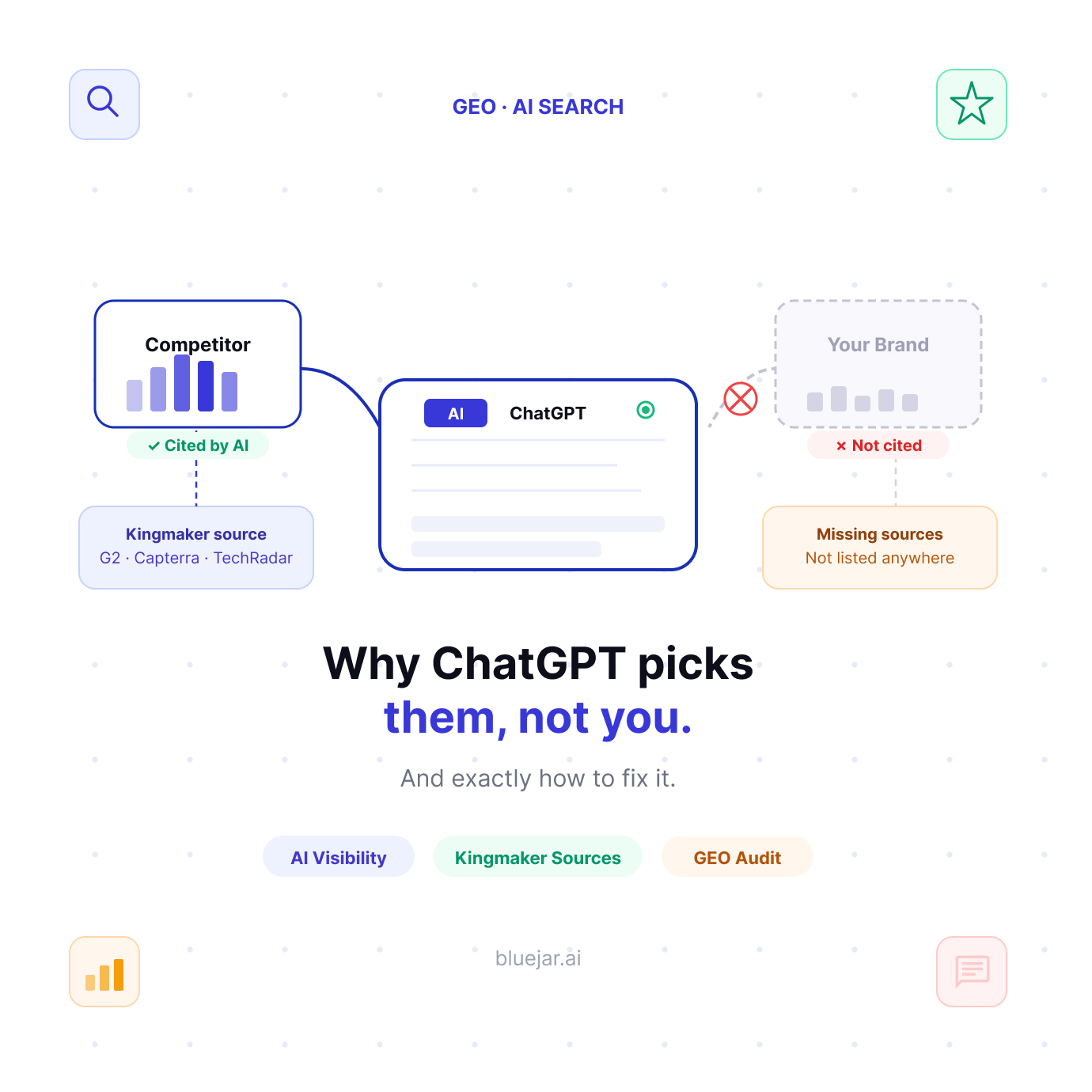
Capture founders and marketing leads searching for answers about AI search invisibility. Make them feel understood, teach them the real mechanism behind AI citations, and position BlueJar as the fastest path from “invisible” to “fixed.” The reader should finish this post thinking: “I need to run a BlueJar audit today.”
The hook — the question every founder is asking
Goal: Grab attention. Make the reader feel seen in the first 10 seconds.
- ✓Open with the exact quote from BlueJar’s pain section: “When someone asks ChatGPT for the best [my category], why does my competitor show up — and I don’t?”
- ✓Acknowledge it’s not a niche problem — every founder with a digital product has typed some version of this into Google in 2026.
- ✓State the core premise of the post: it’s not random, it’s not about ad spend, and it’s completely fixable — once you understand the mechanism.
- ✓One-sentence transition: “Here’s exactly why it happens, and what you can do about it.”
Tone tip: Write this like a founder explaining to a founder, not a consultant pitching a report. Conversational, direct, a little frustrated on their behalf.
Why AI search is different — and why your SEO playbook doesn’t apply
Goal: Educate. Shift the reader’s mental model from “AI is like Google” to “AI is a citation machine.”
- ✓Explain the fundamental difference: Google ranks pages. AI engines synthesize answers by pulling from a curated source set — not the whole internet.
- ✓Introduce the concept of “AI search as the new organic channel” — no ad auction, no CPC, no domain authority arms race. Just sources.
- ✓Make it concrete: ChatGPT, Perplexity, Gemini, and Copilot all have different source weighting — which is why your brand might appear in one and be invisible in another.
- ✓Drop the key stat: AI-cited brands convert ~4.4× higher than traditional search traffic (source: Semrush). Buyers arrive pre-qualified.
- ✓Land the point: Your traditional SEO investment does not automatically transfer to AI visibility. This is a separate channel with separate mechanics.
The real reason your competitor shows up and you don’t: kingmaker sources
Goal: Deliver the “aha” insight that makes this post worth bookmarking and sharing.
- ✓Introduce the “kingmaker sources” concept: AI engines don’t synthesize from the entire internet. For every category, they rely on 5–10 trusted sources that act as authoritative references.
- ✓These sources vary by category — what’s a kingmaker in B2B SaaS is different from DTC, different from local services. They’re not always obvious (often not the biggest publications).
- ✓Use a concrete hypothetical: “If you sell project management software, and your competitor is listed on G2, Capterra, and a specific review roundup that Perplexity trusts — and you’re not — the AI will cite them, not you, every single time.”
- ✓Explain the compounding effect: once a source is trusted by AI, every brand on it benefits from every related query. It’s not per-click, it’s structural distribution.
- ✓Bridge to BlueJar: “This is the exact problem BlueJar was built to solve. The audit maps which kingmaker sources exist in your category, which ones your competitors are on, and which ones you’re missing.”
BlueJar example: Show a simplified version of the Kingmaker Sources output — “Source X: competitor A ✓, competitor B ✓, you ✗ — here’s the specific fix.” This is where a screenshot of the fix plan feature would land perfectly.
The visibility matrix: you’re not equally invisible everywhere
Goal: Add nuance — show that AI invisibility isn’t binary, it’s a map. Introduce the BlueJar Visibility Matrix naturally.
- ✓Explain that AI visibility is zone- and persona-specific. Your brand might be cited for “enterprise project management” but invisible for “project management for small teams.”
- ✓Introduce the 7 buyer-intent zones BlueJar maps: Brand Knowledge, Category Presence, Problem Relevance, Feature Association, Competitor Comparison, Industry Authority, Local Intent.
- ✓Explain the Owned / Cited / Partial / Lost status system — so the reader understands how to read the output.
- ✓Key insight: most brands are strong in one or two zones and completely invisible in three or four. Competitors often win in the zones with the highest purchase intent.
- ✓Tie back to the “aha”: “This is why just asking ChatGPT your company name isn’t enough of a test. You need to run the full prompt grid.”
Visual suggestion: Embed the Visibility Matrix screenshot here (feat-1-visibility-matrix.png). Caption it: “BlueJar maps your visibility across 7 buyer-intent zones × every persona in your category.”
What this is costing you — in actual dollars
Goal: Make the urgency financial, not philosophical. Convert “interesting” into “I need to fix this now.”
- ✓Reframe: invisibility in AI search isn’t a vanity metric problem. It’s a revenue leak. Buyers are using AI to shortlist vendors before they ever visit a website.
- ✓Walk through the lost-revenue logic: TOFU queries build awareness → MOFU queries shape shortlists → BOFU queries confirm decisions. If you’re not in the AI answer, you’re not on the shortlist.
- ✓Mention that BlueJar’s Advanced plan includes a lost-revenue model — broken down by funnel stage, by offering, by platform — so you can take this to a budget conversation, not just a marketing one.
- ✓Rhetorical close: “A ‘score’ doesn’t get you budget. A dollar figure does.”
How to fix it: the 4-step process (and why most advice gets this wrong)
Goal: Give the reader a real framework. Make “create better content” feel as useless as it is. Position specific action as the answer.
- ✓Step 1 — See: Map your actual visibility before touching anything. Most brands skip this and optimize blindly. BlueJar runs 400+ prompts across ChatGPT, Perplexity, Gemini, and Copilot and maps the results into the visibility matrix.
- ✓Step 2 — Find the kingmakers: Identify the 5–10 sources that AI engines trust in your specific category. These are not always the publications you’d guess. BlueJar’s Kingmaker Source map shows which sources your competitors are on and you’re missing.
- ✓Step 3 — Get specific: The fix is not “improve your content.” It’s “get listed on this specific URL” and “fill this specific content gap.” Generic advice is why most GEO efforts fail. Prioritize the 3 fixes that move the needle — skip the 30 that don’t.
- ✓Step 4 — Track recovery: Rerun the audit after 60–90 days. AI engine citation patterns shift as your source footprint grows. Watch the Owned and Cited cells expand in the visibility matrix.
BlueJar integration: Each step above maps directly to a BlueJar feature — Visibility Matrix (Step 1), Kingmaker Sources + Fix Plan (Steps 2–3), and re-running the audit (Step 4). This is a natural, non-pushy way to show the product does the whole job.
Why right now is the moment to move
Goal: Create urgency without being hypey. The first-mover argument is real — make it land.
- ✓Remind the reader: there are zero established incumbents in AI search yet. No “AI SEO” agencies operating at scale. No dominant playbook. This is the equivalent of 2004 Google SEO — the window is open.
- ✓Explain the compounding dynamic: once a brand builds citation authority in AI engines, it’s self-reinforcing. AI engines learn to cite sources that are frequently cited. Being first creates a structural advantage, not just a temporal one.
- ✓Close the urgency loop: “The brands moving now are locking in distribution that’s free and durable. The brands waiting are building a catch-up problem.”
Conclusion + CTA
Goal: Summarize, validate the reader’s concern, make the next step feel obvious and low-risk.
- ✓One-paragraph summary: Your competitor shows up in ChatGPT because they’re on the sources AI trusts. That’s fixable. You need to know which sources, which gaps, and which fixes to prioritize — in that order.
- ✓Validate the emotion: “You’re not behind because you built a worse product. You’re behind because this channel is new and the playbook hasn’t been written yet. That’s actually good news.”
- ✓Primary CTA: “Run your free BlueJar audit — 60 prompts, no credit card, results in minutes.” Link to
app.bluejar.ai/signup. - ✓Secondary CTA: “Not sure where to start? Book a 30-min demo.” Link to Calendly.
Ready to run the audit?
BlueJar runs 400+ prompts across ChatGPT, Perplexity, Gemini, and Copilot — then maps exactly where you’re invisible and what to fix. Free. No credit card. Results in minutes.
Run Your Free Audit → or book a demo at calendly.com/suresh-bluejar/30min