Key takeaways
- If your AI leads are mostly tire-kickers, students, and free-plan hunters, the problem is usually not your website. It is the queries you show up for. AI search lead quality is set upstream, by which query surfaced you, before anyone reaches your site.
- Every topic has an intent ladder. “What is a CRM” pulls browsers. “CRM that syncs with QuickBooks, with pricing” pulls a buyer with a use case and a budget. If AI names you mostly on the curious rung, you get volume and most of it is low intent.
- Rewriting the homepage cannot fix a mismatch that happened before the click. According to 6sense, buyers now contact a vendor only 61% of the way through their journey, and the winning vendor is already on the Day One shortlist 95% of the time.
- The fix is upstream: find the buying queries in your category, check whether AI names you on them today across ChatGPT, Perplexity, Gemini, and Copilot, then earn the ones it does not. Fewer people, far higher buyer share.
Leads start coming in from ChatGPT and it feels like a win. Then you read the inbox. A student on a class project. Someone who wanted the free plan and bounced the second a price showed up. A browser who was “just looking.” The volume is real, the quality is not, and the instinct is to fix the website. Usually the website is fine. What sets your AI search lead quality is the query that surfaced you, and that got decided before anyone reached your site.
Here is the line I keep using with agency clients: lead quality from AI is mostly a query-targeting problem wearing a website-problem costume. The leads are low intent because the query was a browsing query, not a buying one. And the engines confirm where the buying decision really happens. According to 6sense’s 2025 B2B Buyer Experience Report, buyers now reach out to a vendor only 61% of the way through their journey, and the winning vendor is already on their Day One shortlist 95% of the time. That shortlist forms while they are still asking queries. Miss the right queries and you never make the list.
This is for two readers: the agency hearing “your AI leads are garbage” from a client, and the brand staring at its own junk inbox. I will walk the intent ladder on one topic, show why the homepage is the wrong lever, and lay out the upstream fix that changes who shows up.
Every topic has an intent ladder
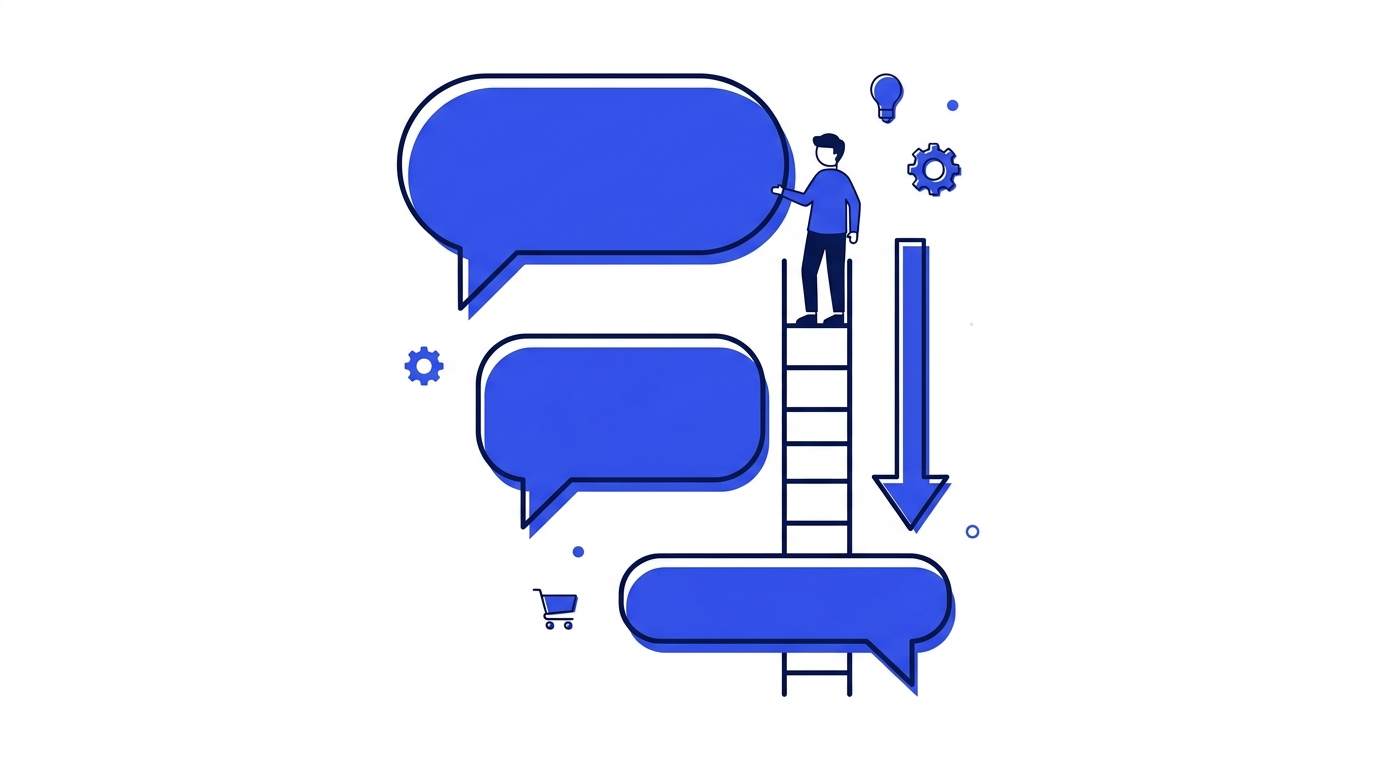
Pick any category and the queries people ask about it sit on a ladder. Broad and curious at the bottom, narrow and ready to buy at the top. The same buyer climbs it over days or weeks, and the people sitting on each rung are completely different. Take CRM software. These example queries are illustrative, but the pattern holds for almost any category you sell into:
| Rung | Example query (illustrative) | Who asks it | Lead quality |
|---|---|---|---|
| Curious | “what is a CRM” | Students, browsers, researchers, the merely curious | High volume, mostly low intent |
| Comparing | “best CRM for a small team” | Fence-sitters narrowing a list, no firm timeline yet | Medium volume, mixed intent |
| Ready to buy | “CRM that syncs with QuickBooks, with pricing” | A buyer with a use case, a budget, and a deadline | Low volume, high buyer share |
Read the top row and the bottom row back to back. “What is a CRM” is asked by people who, by definition, do not yet know what a CRM is. Some are students. Most are just orienting. Almost none have a budget approved this quarter. “CRM that syncs with QuickBooks, with pricing” comes from someone who already runs QuickBooks, already has the problem, and is close enough to buying that they want the number. One query hands you a crowd. The other hands you a buyer.
The consumer data shows how lopsided the curious end is. Adobe Analytics found that among people who use AI for shopping, 57% use it mainly for product research and 43% use it for deal-seeking. Research and bargain-hunting dominate the use mix, and that is a lot of people sitting on the curious and price-shopper end. A separate Omnisend survey of 1,224 US shoppers put the same number at 57% using AI primarily to research products, with 65% of AI shoppers preferring ChatGPT. So the bulk of the volume, and the bulk of the curiosity, runs through the one engine your junk leads are coming from. Keep getting named for the queries those people ask, and you will pull plenty of leads, most of them the tire-kickers you are complaining about.
Why the website is the wrong lever
When the leads are bad, the reflex is to blame the funnel. Rewrite the homepage hero. Add a qualifying field to the form. Tighten the copy. None of that touches the cause, because the mismatch happened one step before the website even entered the story. Walk the sequence. A buyer asks ChatGPT a query. ChatGPT names you in the answer. They read it, maybe click through, maybe not. If the query was “what is a CRM,” the person reading your name was never a buyer. By the time they hit your freshly rewritten homepage, the quality of that lead was already set, upstream, by the query. A page cannot un-curious a curious visitor.
And most of them never reach the page at all. Pew Research Center tracked the real browsing behavior of 900 US adults and found that when an AI summary appears, people click a traditional search result in just 8% of visits, and click a link inside the summary itself in only 1%. So you are tuning a page most of your AI audience never visits, to fix a problem that was decided before they would have visited it. Two layers of wrong lever.
There is a tell that this is happening to you. The AI visitors who do land usually look engaged, not lazy. Adobe found that people arriving from generative AI spend about 8% longer on site, view 12% more pages, and bounce 23% less than visitors from other channels. They were also 9% less likely to convert on that visit, though that gap had narrowed sharply from 43% a year earlier. Read those two facts together: the people showing up are reading deeply and not buying yet. On the ready-to-buy rung that is a healthy research visit. On the curious rung it is a student writing a paper. Same engagement signature, completely different lead. The website cannot tell them apart, and neither can a homepage rewrite.
So before you touch a line of page copy, ask the upstream query. Which rung of the ladder is AI putting you on? If the honest answer is the curious one, the page was never the issue.
The decision happens before they reach your site
Here is the part that reframes the whole problem. The shortlist a buyer pulls from gets built while they are still asking queries, long before they fill out your form or talk to sales. The 6sense numbers are blunt about it. The winning vendor is on the buyer’s Day One shortlist 95% of the time, up from 85% the year before. That shortlist holds about four vendors, and the pre-contact favorite goes on to win 77% of the time. Buyers reach out only 61% of the way through their journey, six to seven weeks sooner than they used to. The survey covered nearly 4,000 buyers on deals with a median cost of $200,000 to $300,000, so this is not a fringe pattern. It is how serious purchases get made now.
Put the two ideas together. The shortlist forms during the query-asking phase, and AI is increasingly the thing answering those queries. Bain & Company found 42% of people who use large language models ask them for product recommendations, and around 80% of consumers lean on AI-written answers for at least 40% of their searches. So AI is the shortlist-builder now, and whether you make the list comes down to which queries name you. Win the curious ones and you land on a lot of “things I read about while orienting” lists that go nowhere. Win the ready-to-buy ones and you land on the four-vendor shortlist that 95% of winners come from.
If you sell into a more technical or B2B category, the gap is even sharper because the buying queries are so specific. We dug into that in GEO for SaaS and B2B in AI search, where the ready-to-buy queries name integrations, use cases, and price tiers that a curious browser would never think to ask.
Step one: find the buying queries in your category
The fix starts with a real list of the ready-to-buy queries, not a guess at them. These carry a use case, a constraint, or a price intent baked in. They sit on the bottom rung of the ladder, and they are where your best-fit buyers live. A few places to mine them:
- Your own sales and demo notes. The exact phrasing a buyer uses to describe their problem (“we need something that connects to QuickBooks and our team is five people”) is a ready-to-buy query in disguise. Steal it.
- Search Console long-tail queries. Pull the queries already getting impressions and sort for the specific, comparison, and “with pricing” phrasings. They overlap heavily with how people ask AI, and it is the closest free thing to a list of real buyer demand.
- Forum threads in your category. Reddit and niche communities are where buyers ask the awkwardly specific queries they would never type into a clean search box. Gold for the ready-to-buy rung.
Sort what you collect into the three rungs, and be honest about which is which. The ready-to-buy pile will be smaller than the curious one. That is the point. You are trading volume for buyer share on purpose. For agencies, this sort is also the most persuasive part of a pitch: it makes the client’s “bad leads” complaint concrete and shows exactly where the gap is. We covered that conversation in how to pitch GEO services to clients.
Step two: check whether AI names you on them today
Once you have the buying queries, find out which ones AI already hands to you and which ones it hands to a competitor. This is the measurement step, and it is where most of the real information lives. Run each ready-to-buy query across the engines that matter, ChatGPT, Perplexity, Gemini, and Copilot, plus Google AI Overviews as a fifth surface. The same query often returns a different shortlist on each one, so a single engine tells you almost nothing. One run tells you even less. AI answers are non-deterministic, so the same prompt asked twice can name different brands. Ask each query several times on each engine and record how often you appear. “Named in 7 of 10 runs” is signal. “Showed up the one time I checked” is a coin flip.
When you do this, sort the results into three honest states, because they call for different fixes:
- Named and cited. AI mentions you and links your page as a source. You own this query. Protect it.
- Cited but not named. Your page is in the source list but your brand never appears in the answer the buyer reads. That is a content and structure gap.
- Absent entirely. Neither your brand nor your page shows up. This is an off-site gap, a query of which third-party pages the engine trusts for your category, and it is usually the biggest lever.
A blended “you are 40% visible” score hides all three. You need to know, query by query, which buying queries you win and which you lose, and to whom. Setting that baseline once is the whole game, and what a GEO score measures is a good primer on what to actually record. If you want to turn this into an ongoing log of where your brand surfaces across engines, how to track brand mentions in AI search walks through the setup.
Step three: earn the ready-to-buy queries you don’t win
Now you have a list of specific, high-intent queries where AI names a competitor instead of you. This is the work, and it splits into two lanes depending on what your measurement found.
If you were absent entirely, the lever is off-site. AI assembles answers from a small, repeatable set of third-party pages per category query: the comparison posts, the roundups, the review pages, the forum threads. If a competitor is on those pages for “best CRM that syncs with QuickBooks” and you are not, the fix is getting onto those pages, not rewriting your own. That is earned-placement work, closer to digital PR than to on-page SEO. How to get cited by ChatGPT goes deeper on which sources the engines trust.
If you were cited but not named, the lever is your own content, but a specific kind. You need pages that answer the ready-to-buy query directly, in the buyer’s own words. A page literally about the QuickBooks integration with the pricing on it. A comparison page for the exact match-up buyers ask about. Clear, extractable, specific. Not a broad “what is a CRM” explainer, which only feeds you more curious traffic and makes the problem worse.
The trade, said plainly: you will likely get fewer total AI leads, because you are stepping back from the high-volume curious queries on purpose. But a far higher share of the leads you do get will be best-fit buyers with a real use case, because you are now the name on the queries only buyers ask. You move from “added to a list of things someone read about” to “added to the four-vendor shortlist that 95% of winners come from.”
For agencies, this is also the cleanest way to reframe a client who thinks AI is sending them garbage. The leads are not garbage. They are correctly matched to the queries the client currently wins, which happen to be the wrong queries. Show them the ladder, show them where AI names them today, and the path forward sells itself. There is more on packaging that for clients in GEO for digital marketing agencies.
Run your free GEO audit at bluejar.ai to see which buying queries name you across ChatGPT, Perplexity, Gemini, and Copilot, which ones name a competitor instead, and exactly where your best-fit buyers are slipping through.
Frequently asked questions
Why are my ChatGPT leads such low quality?
Usually because AI is naming you on broad, curious queries like “what is a CRM” rather than specific, ready-to-buy queries like “CRM that syncs with QuickBooks, with pricing.” The curious queries are asked by students, browsers, and free-plan hunters, so the leads they produce are high in volume and low in intent. The quality was set by the query, before anyone reached your site.
Should I fix my website to improve AI lead quality?
Rarely, and not first. The mismatch that produces junk leads happens upstream, when AI surfaces you for a browsing query instead of a buying one. Pew Research found people click into a page in only 8% of visits when an AI summary appears, so you would be tuning a page most of your AI audience never sees. Re-target the queries before you rewrite the page.
What is the intent ladder?
It is the range of queries people ask about a topic, from broad and curious at the bottom to narrow and ready-to-buy at the top. “What is a CRM” sits at the bottom and pulls browsers. “Best CRM for a small team” sits in the middle and pulls comparers. “CRM that syncs with QuickBooks, with pricing” sits at the top and pulls real buyers. Where AI names you on that ladder decides your lead quality.
How do I find the ready-to-buy queries in my category?
Mine your own sales and demo calls for the exact phrasing buyers use to describe their problem, pull low-CTR long-tail queries from Google Search Console, and read the specific queries buyers ask in Reddit and niche forums. Sort everything into curious, comparing, and ready-to-buy rungs. The ready-to-buy pile will be smaller, which is the point.
Does ranking number one on Google mean AI will recommend me for buying queries?
No. AI engines assemble answers from sources they trust, including third-party comparison pages, reviews, and forum threads, which is a different source model from the blue links. You can rank first on Google and still be absent the moment a buyer asks ChatGPT for a specific recommendation, while a lower-ranked competitor gets named instead.
How can I tell which buying queries AI names me for?
Run each ready-to-buy query across ChatGPT, Perplexity, Gemini, and Copilot several times each, since the answers vary run to run, and record how often you appear. BlueJar does this at scale with a structured set of queries across all four engines, sorts each result into named, cited, or absent, and shows you query by query where a competitor is winning the recommendation. That map is what tells you which queries to go earn.
Will targeting buying queries reduce my total lead volume?
Probably, and on purpose. You are stepping back from high-volume curious queries and competing for fewer, higher-intent ones. According to 6sense, the winning vendor is on the buyer’s Day One shortlist 95% of the time, so being the name on the queries buyers actually ask matters far more than raw volume. Fewer leads, much higher buyer share, is the trade.
How often should I re-check which queries AI names me for?
Treat it as a baseline you re-run on a cadence, not a daily dashboard. AI answers wobble run to run and the models update on their own schedule, so checking every morning mostly shows you noise. Set a baseline, do the earning work, then re-run quarterly or after a meaningful content or earned-placement push to confirm the trend moved.