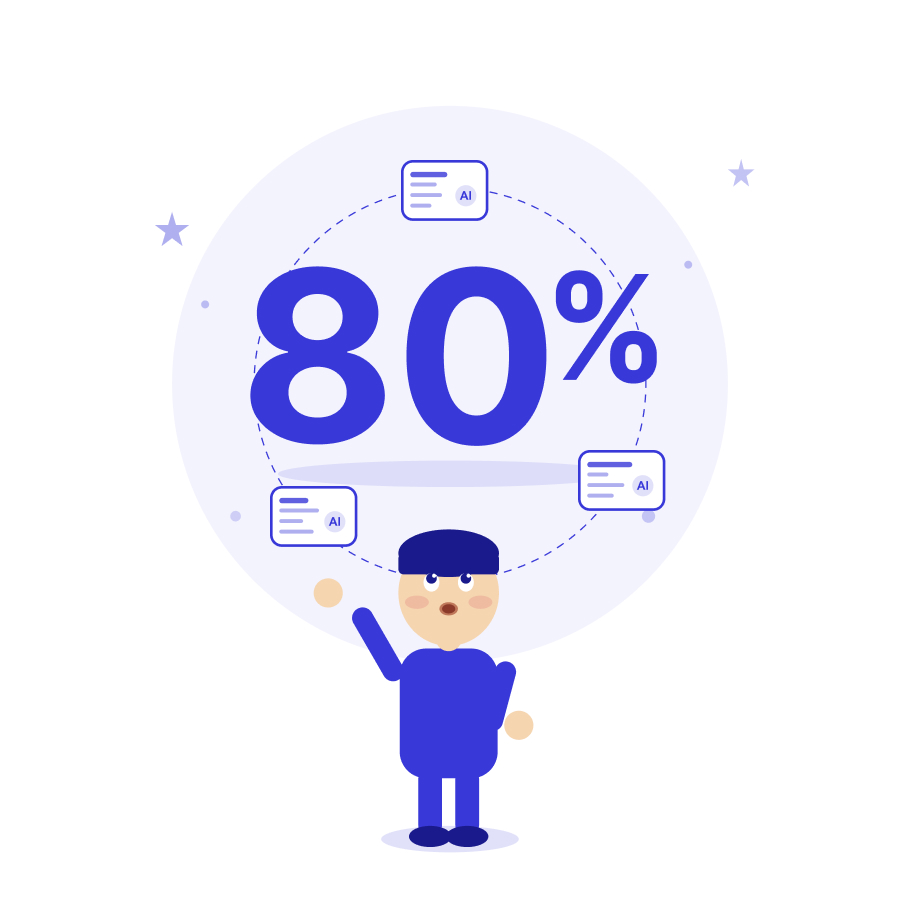
Eight out of ten searches now end without a click. The user gets their answer directly from ChatGPT, Google’s AI Overview, Perplexity, or Claude, and your blue-link ranking — no matter how hard-won — never enters the picture.
That’s the gap GEO closes. If AI engines can’t read your page well enough to cite you, you’re invisible to a growing slice of search demand. And “invisible” is more expensive than “ranked #4.”
Below: the five things AI engines actually look at when they decide whose words to put in an answer, and how to tell whether your site clears each bar.
Why “rankable” stopped being enough
Traditional SEO optimized for two things: getting indexed and earning a click. Both assumed a results page. AI search collapses that page into a single synthesized answer, which means the value of a top-10 slot has split in two:
- Being cited. Your URL appears as a source under the AI’s answer.
- Being mentioned. Your brand name shows up in the answer text itself.
Most sites that rank well today are doing neither. Not because their content is bad, but because the signals AI engines weigh have shifted under their feet. Five categories now decide whether you’re citation-grade material.
1. Schema markup: machine-readable or machine-skipped
Schema.org structured data is how you tell an LLM what kind of content it’s looking at. Without it, a model has to infer that “Dr. Anika Patel” is the author, that the article is 1,400 words about backlink decay, and that the publish date matters. With proper Article, FAQPage, HowTo, and Organization schema, that work is done for it.
Common gaps we see in audits:
Articleschema missingauthor.urlordateModifiedFAQPageschema that doesn’t match the actual on-page Q&A blocks- No
Organizationschema linking the site to a real-world entity
Each gap is a small reason for the engine to pick someone else.
2. E-E-A-T: do you exist outside your own website?
Experience, Expertise, Authoritativeness, Trustworthiness. Google’s quality framework now doubles as AI search’s filter for who gets cited. The signals AI engines weigh aren’t subtle:
- Named authors with bylines, bios, and credentials
- External profiles (LinkedIn, professional bodies, academic affiliations)
- Citations of your work from sites the engines already trust — your Kingmaker Sources
- A clear
Organizationschema with verifiable address, founders, and contact paths
If the author of your flagship post is “Admin,” you’re handing the citation to someone else.
3. Citation-readiness: write so a model can quote you
Citation-ready content isn’t a vibe. It’s structural. AI engines prefer passages they can lift into an answer with minimal rewriting: clean definitional sentences, named entities, hard numbers, and dates.
Compare these two openings:
“There are many factors that can influence how visible your site is to AI search tools, and the landscape is constantly evolving.”
“Eight of every ten searches in 2025 end without a click. Roughly 60% of AI Overview citations come from sites with FAQ schema.”
The second one gets quoted. The first one gets skipped. Citation-readiness audits look at first-paragraph density, definitional sentence count, stat-to-prose ratio, and whether your H2s answer real questions instead of teasing them.
4. Content structure: H2s that match the prompts people ask
LLMs chunk content. They read pages section-by-section, scoring each chunk for relevance to a query. A page with one giant H2 and 1,800 words of prose underneath gets scored as a single blob. A page with 8 targeted H2s, each matching a question someone might actually ask, gets eight chances to be cited.
The fix isn’t subtle:
- Convert paragraph-buried questions into H2s
- Keep each section short enough to be quotable on its own (150–300 words)
- Put the answer in the first sentence of the section, not after a windup
If you wouldn’t paste a section into an AI chat and get a useful standalone answer back, the engine won’t either.
5. Technical SEO: still the floor
None of the above matters if the engine can’t crawl you. The unglamorous foundation still applies:
- A
robots.txtthat allows the AI crawlers you want (GPTBot, Google-Extended, PerplexityBot, ClaudeBot) - Server response times under 600ms for crawler IPs
- Canonical tags pointing where you actually want citation credit to land
- An XML sitemap that includes the pages you most want cited, not just every post
Most sites we audit have at least one AI crawler blocked at robots.txt, sometimes by a CDN default they didn’t know was there.
How to tell if your site is citable
You can spot-check this manually. Open ChatGPT or Perplexity, ask three questions a customer would actually type, and look at the citations. Are you in them? Is a competitor? Is the cited source weaker than your equivalent page?
If the answer is “no, yes, and yes,” you have a GEO problem, not a content problem. A GEO audit runs that check across 400+ prompts on 4 AI platforms and tells you which of the five categories above is dragging your visibility down, with the specific fixes ranked by impact.
The 80% number isn’t going down. The window to fix this while competitors are still arguing about whether AI search matters is the part that’s closing.
Frequently asked
What’s the difference between SEO and GEO?
SEO optimizes for ranking on a search results page. GEO (Generative Engine Optimization) optimizes for being cited or mentioned inside an AI-generated answer. Both can coexist, but they reward different signals: GEO weighs schema, E-E-A-T, and citation-readiness more heavily than traditional keyword density.
Which AI engines should I optimize for?
ChatGPT, Google AI Overviews, Perplexity, and Claude account for the bulk of AI search traffic in 2025. Each has slightly different citation behavior, but the underlying signals (schema, E-E-A-T, structure, technical) overlap enough that a single GEO program covers all four.
Do AI engines use the same backlinks as Google?
Not exactly. AI engines weigh “Kingmaker Sources” — a smaller set of high-trust domains they treat as authoritative — more heavily than the long tail of links Google considers. Earning one citation from a Kingmaker Source often outweighs dozens of standard backlinks.
How long does it take to see GEO improvements?
Schema and technical fixes can show up in AI citations within 2–4 weeks. E-E-A-T and citation-readiness improvements take longer (8–12 weeks) because they depend on the AI engines re-crawling and re-evaluating your site against competitors.