AI Citation Tracker
AI Citation Tracker: Win Your Market in AI Search & Drive Inbound Leads
Turn ChatGPT, Perplexity, Gemini, and Copilot into your highest-converting sales pipeline.
Modern buyers ask AI tools for direct recommendations. If AI models aren’t citing your brand, you are losing high-intent deals to competitors. Showing where you stand is the job of an AI citation tracker; we then work to make your business the one they recommend.
Request a Free AI Visibility Snapshot & Growth Plan
Explained
What is an AI citation tracker?
An AI citation tracker measures how often AI answer engines attribute an answer to your domain — which of your URLs get used as sources, how often, on which questions, and which other domains are cited in your place. It records the answer's sources, not just its text.
That makes it different from a visibility or mention tracker, which records whether your brand name appears in the answer. The two can move independently: an engine can recommend you warmly while citing a review site rather than your own pages, and it can cite your documentation while recommending a competitor by name.
The process
How it works, in four steps
Understand your business
We read your website and map your services, your customers, what they care about, and what makes them start looking.
Free snapshot
- Brand overviewBusiness type, offerings, known competitors and the buying stages to analyze.From your website
- PersonasThe buyer personas we identified. Edit, remove or add your own.6 personas
- PrioritiesThe business priorities, based on your offerings.8 priorities
- TriggersThe real-life moments that cause customers to search AI.15 triggers
- PromptsSample prompts to review before the full set runs.30 samples
Test customer questions
We identify your competitors and ask AI tools the questions your customers ask, in the markets you serve.
Free snapshot
Known Competitors
- Firm Afirm-a.example
- Firm Bfirm-b.example
- Firm Cfirm-c.example
- Firm Dfirm-d.example
We’ll also surface other competitors taking AI search visibility in your category during the analysis.
Show findings and priorities
You see where you appear, where you’re missing, and who is named instead, with a short list of what to fix first.
Free snapshot: first fixes · Full plan with ongoing service
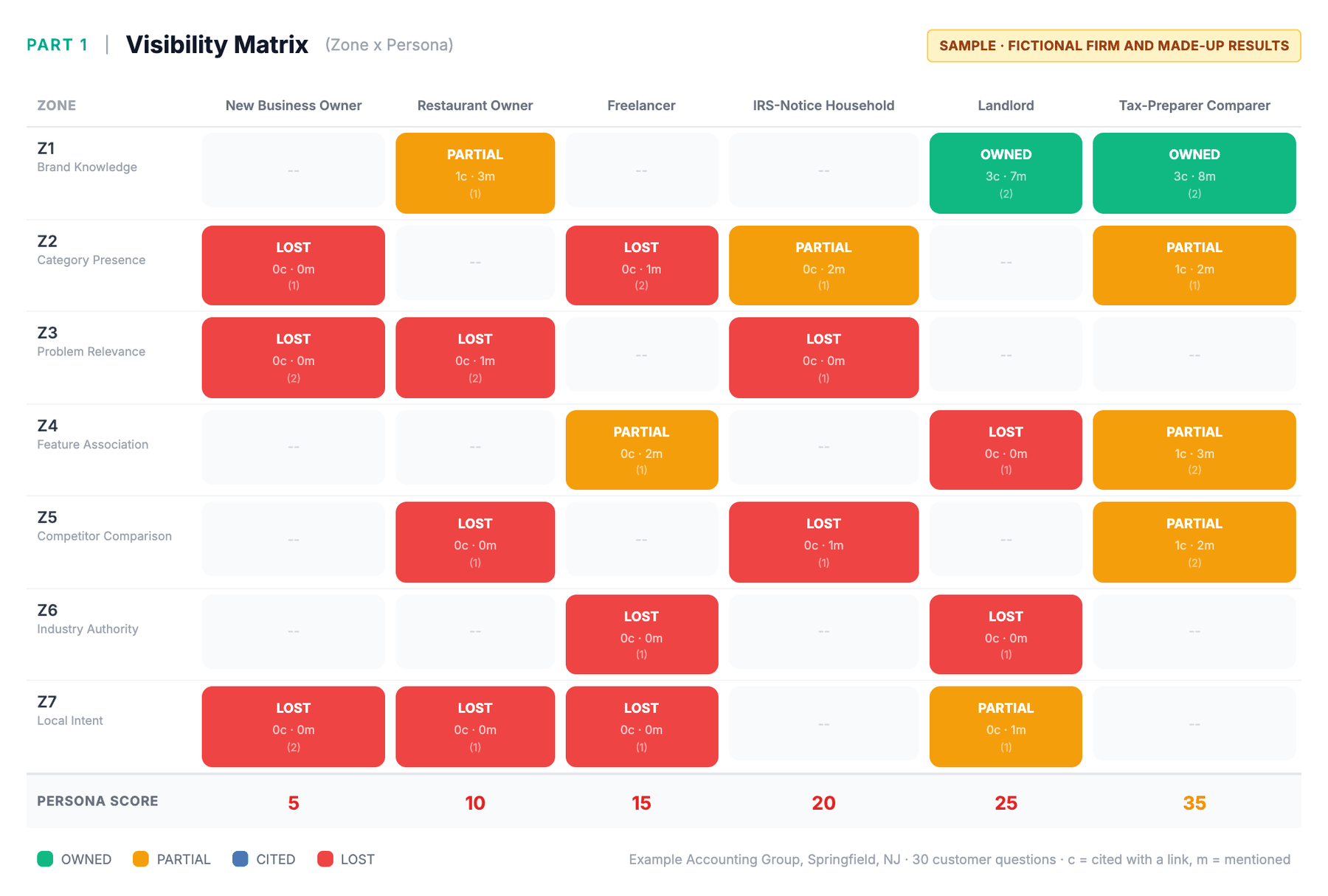
Sample with a fictional firm and made-up results. The layout is the app’s Visibility Matrix. Enlarge Make approved improvements and measure progress
With your approval, we make the fixes on your site and listings, then re-run the same questions each month.
Ongoing service
6 Fixes to Improve AI Visibility (first 4 shown)
- Correct the service listTwo profiles list tax preparation only. Match the website: tax, bookkeeping and payroll.P1
- Complete directory profilesFill in services, credentials and service area on the profiles the firm already has.P1
- Answer local customer questionsA small-business bookkeeping page for Springfield and nearby towns.P2
- Structured data on key pagesMarkup that tells AI tools what the firm does and who it serves.P2
Roadmap
- FirstP1 fixes, after your approval
- NextP2 fixes, after your approval
- ThenSame prompts re-run each month
What you receive
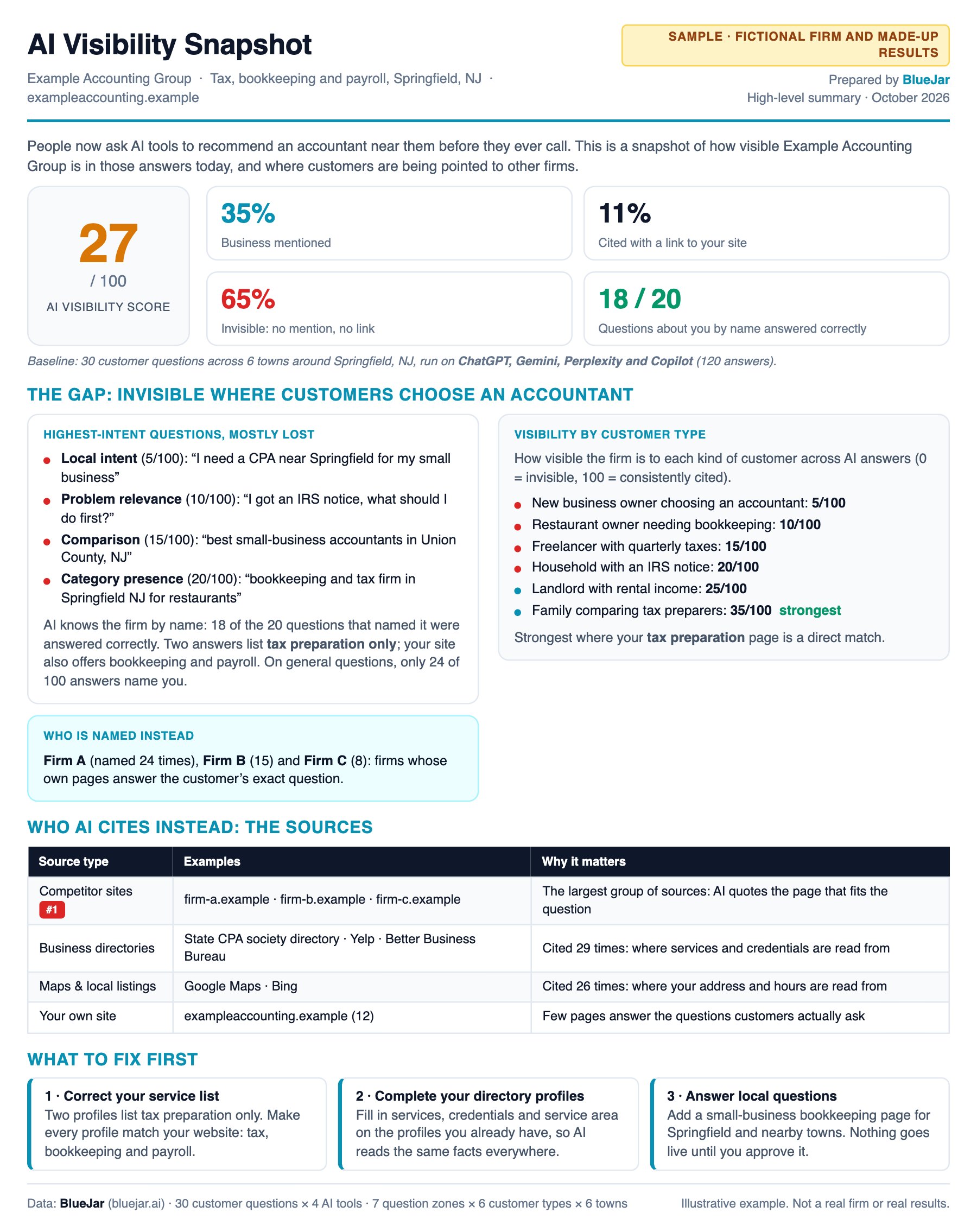
Your snapshot, in three parts
Where you appear
The questions where AI tools name your business, and where they don’t.
Who is named instead
The competitors and sources AI points your customers to.
What to fix first
A short, prioritized list of fixes to start with.
FAQ
Questions
What is the difference between an AI mention and an AI citation?
A mention is your brand name appearing in the answer text. A citation is a URL or domain being attributed as the source the answer was built from. They are independent: you can be recommended by name while the answer cites a review site, or have your page used as a source while the answer recommends someone else. Tracking only mentions hides which of the two is actually failing.
Can I be cited by an AI engine without being mentioned?
Yes, and it is more common than people expect. It typically happens when your content explains a topic well without making a case for your product — a good documentation page or blog post gets used as the factual basis while the recommendation goes to a competitor. It is one of the most fixable situations in this whole discipline, because the engine has already accepted your page as trustworthy.
Which AI engines actually show their sources?
Perplexity is the most transparent and attributes sources openly in the answer. Copilot generally surfaces links, drawing on the Bing index. Gemini shows sources inconsistently depending on the question. ChatGPT cites when it retrieves but often answers from what the model already knows, with no links at all. Because of that spread, a citation figure only means something when you know which engine produced it.
Can you guarantee more leads or AI recommendations?
We improve your website and business information, then test and refine monthly to strengthen AI visibility and create more opportunities for inbound leads. Results aren’t guaranteed, but each step is guided by measured progress.
First-mover advantage
AI answers name only a few businesses. Be one of them first.
AI search optimization is still new, and it rewards the businesses that move early: winning a recommendation now is easier than displacing a competitor later. See where you stand in your market before your competitors look.
No one can guarantee AI recommendations or leads. We show where you stand, fix what is in your control, and measure the change.