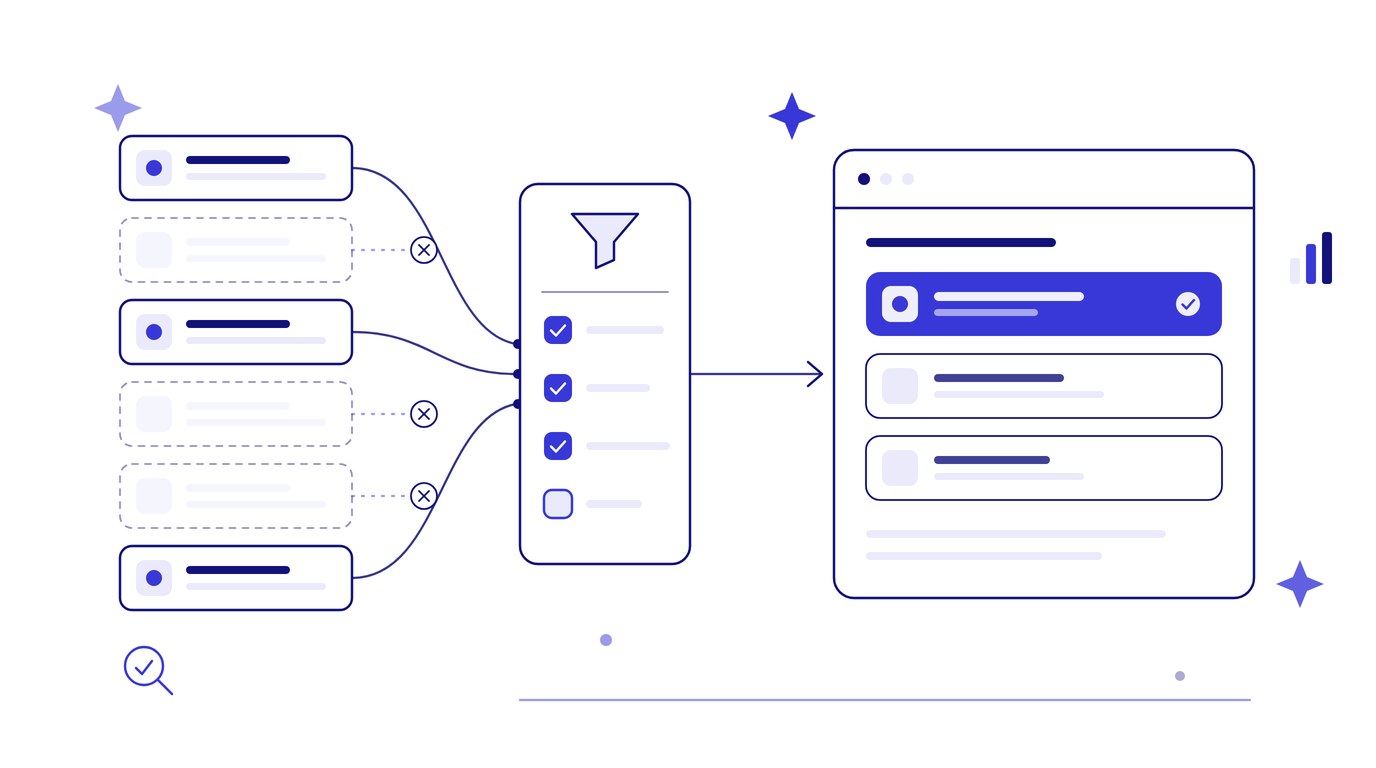
A buyer types one sentence into ChatGPT: “Find me three project management tools under $15 a seat that integrate with HubSpot and have SOC 2.” The assistant reads a few dozen pages, drops most of the market, and comes back with three names. The buyer books demos with those three. Everyone else lost the deal without ever knowing they were considered.
That is the moment assistive agent optimization (AAO) is about. Not the AI writing a nice answer that mentions you, but the AI doing part of the buyer’s job (searching, filtering, comparing, and sometimes acting) and deciding whether you survive that job.
There is a lot of excitement right now about agents that “buy on your behalf.” Some of it is ahead of reality. This post separates the two, then gives you a checklist you can run this week.
What assistive agent optimization means
AAO is the practice of making your business easy for an AI agent to evaluate, select, and act on when it works for a human. The term was popularised by Jason Barnard, who places it after SEO (be found), AEO (be the answer), and GEO (be recommended) as the stage where the goal is to be chosen.
The useful difference is not the new acronym. It is that the agent has a task with constraints. A chatbot answering “what is the best CRM?” is writing a summary. An agent asked to “shortlist a CRM under $50 a seat with a native Shopify integration” is running a filter. Summaries reward being well-known. Filters reward being verifiably eligible. If you want the wider map of the acronyms, our SEO vs GEO vs AEO terminology guide covers it.
The reality check: agents shortlist today, they rarely buy
The “agents are already buying” story usually points to three pieces of infrastructure. Here is where each actually stands as of October 2026:
| Infrastructure | What it promised | Where it stands |
|---|---|---|
| OpenAI Instant Checkout (Agentic Commerce Protocol, with Stripe) | Buy inside ChatGPT without visiting the store | Launched September 2025, pulled back in March 2026. ChatGPT now sends shoppers to the retailer’s own checkout. The protocol itself lives on as an open standard. |
| Google Universal Commerce Protocol (UCP) | Agents handle discovery, checkout and post-purchase | Announced January 2026. Checkout runs in AI Mode and Gemini for eligible US retailers. Retail only, and still rolling out. |
WebMCP (navigator.modelContext) |
Websites expose actions (“book a demo”, “get a quote”) that browser agents can call directly | Early preview in Chrome since February 2026, behind a flag. The API is still changing. |
The pattern is clear. The plumbing for agents to complete purchases exists, but the one large consumer rollout to date was reversed, and the rest is retail-only or experimental. Meanwhile the part that needs no new protocol, agents researching and narrowing the options, is happening in every buying conversation that starts in ChatGPT, Perplexity, Gemini, or Copilot.
So for most companies, the practical version of AAO in 2026 is this: make it past the agent’s shortlist. Whether a human or an agent clicks “buy” afterwards matters less if you were never on the list.
How an agent narrows the field
When an assistant handles a constrained request, it roughly does three things. Each one eliminates vendors for a different reason.
- Gather candidates. It pulls names from what it already knows plus a live search. If you are not well represented in the sources it trusts, such as review sites, comparison articles, and forums, you never enter the pool. This is the classic kingmaker sources problem.
- Check constraints. For each candidate it looks for evidence of the hard requirements: price, integrations, compliance, region, size limits. This is where AAO differs most from GEO. A vendor that meets the requirement but doesn’t say so anywhere the agent can read gets treated the same as one that fails it.
- Rank and justify. It orders the survivors and writes a reason for each. Agents tend to favour options whose claims are confirmed by more than one source, so a fact that only appears on your own site carries less weight than the same fact repeated on G2 or in an independent review.
Step 2 is the one most teams have never looked at, and it is the cheapest to fix. We call the failure elimination by missing fact: you lose not because a competitor is better, but because the agent couldn’t confirm you qualify.
The common ways vendors get eliminated
- “Contact us for pricing.” An agent asked for “under $15 a seat” can’t confirm you qualify, so it moves on to the vendor who published a number. Even a “from $X” figure is better than nothing.
- Integrations shown only as logos. A wall of partner logos is an image grid. The text “Native two-way sync with HubSpot, Salesforce and Pipedrive” is evidence.
- Compliance buried in a PDF or gated trust portal. If SOC 2, HIPAA or GDPR status matters to buyers, state it in plain HTML on a public page.
- Facts that disagree across the web. Your site says 14-day trial, your G2 listing says 7, a 2024 review says free tier. Conflicting evidence makes you a risky pick, and the agent picks someone else.
- Content that only exists after JavaScript runs. Many AI fetchers read the raw HTML. If your pricing table is rendered client-side, the agent may see an empty page. Our technical GEO stack guide covers how to test this.
- Bot blocking you didn’t choose. A CDN or firewall rule that challenges unknown user agents can turn away
ChatGPT-User,Claude-UserorPerplexity-User, the fetchers that act on a live user request, even when your robots.txt allows them.
The agent-readiness check: 8 things to fix first
You can run all of these in an afternoon. They are in order of payoff for a typical B2B or service business.
- Write your constraint sheet. List the 10 facts buyers filter on in your category: price, plan limits, integrations, compliance, regions served, deployment, support hours, contract terms. Ask your sales team which questions disqualify deals. This list is your AAO spec.
- Put every constraint in plain text on a public, crawlable page. Pricing, integrations and security pages are the natural homes. Use the exact words buyers use (“SOC 2 Type II”, “native Shopify app”) rather than marketing paraphrase.
- Publish a number. If full pricing isn’t possible, publish a starting price or a typical range. An agent can work with “from $49 a month”. It cannot work with a form.
- Fetch your key pages as raw HTML. Run
curl -s https://yoursite.com/pricing/ | grep -i "per seat"or equivalent. If the facts aren’t in the response, agents that don’t render JavaScript won’t see them. - Check robots.txt and your firewall separately. Allow the search and user-request fetchers you want (
OAI-SearchBot,ChatGPT-User,Claude-User,PerplexityBot), then confirm with your CDN logs that they actually get a 200, not a challenge page. - Mirror the facts in structured data.
Organization,ProductorSoftwareApplicationwithOfferpricing, andFAQPagefor the constraint questions. Schema should repeat what the page says, not add claims the page doesn’t make. - Reconcile your third-party listings. Go through G2, Capterra, industry directories and your top comparison articles. Fix any fact that disagrees with your site. Agents gain confidence from corroboration, and a correction to a stale listing often does more than a new page.
- Say who you are not for. A clear “best for teams of 10 to 200; not built for enterprise procurement” helps an agent match you to the right requests and keeps you out of the wrong ones. It also cuts the junk leads that come from wrong-fit AI recommendations.
What you can safely wait on
Unless you sell physical products online, you don’t need an MCP server, a WebMCP integration, or an agent-payments setup this quarter. These are worth watching, and worth a prototype if your product is a natural “action” (bookings, quotes, reorders), but no mainstream assistant routes B2B buyers through them today.
E-commerce is the exception. If you sell products, keep your Google Merchant Center feed complete and accurate, because that feed is what UCP checkout and AI Mode shopping draw on. Product data quality (price, availability, shipping, returns) is the retail version of the constraint sheet. Our post on getting Shopify stores AI-ready goes into this.
How to measure AAO: track selection, not mentions
GEO measurement asks “do AI answers mention us?” AAO measurement asks a harder question: “when the request includes real constraints, do we make the shortlist, and if not, why not?”
- Write constrained prompts. Take your constraint sheet and turn it into 20 to 30 realistic requests: “under $X”, “works with Y”, “for a team of Z in the UK”. Include constraints you meet and a few you don’t, so you can tell whether agents are filtering accurately.
- Record a selection rate. Per prompt and per engine, note whether you were shortlisted. Run each prompt several times. AI answers vary from run to run, so one check isn’t a measurement (here’s why).
- Log the reason for exclusion. When you are left out of a prompt you qualify for, ask the assistant why, or check which sources it cited. The answer usually points straight at a missing or conflicting fact.
- Watch for false negatives. Being left out of requests you do qualify for is the core AAO failure. Each one maps to a fix on the checklist above.
AAO doesn’t replace GEO, it adds a last mile
Everything that gets you mentioned still matters: a clear entity, strong third-party sources, crawlable and citable pages. AAO adds one more requirement on top. Once you’re in the pool, the agent must be able to verify you fit the brief. Brands that have done GEO well are most of the way there. What they usually lack is a deliberate list of buyer constraints and a place on the web where each one is plainly confirmed.
The transaction layer will arrive eventually, in some form. When it does, the vendors who already make the shortlist will be the ones agents complete purchases with. The work you do now on facts, consistency and access carries straight over.
Want to know whether AI assistants shortlist you or a competitor? Get a free snapshot of what ChatGPT, Gemini, Perplexity and Copilot say about your business, emailed within 2 business days.
Frequently asked questions
What is assistive agent optimization (AAO)?
Assistive agent optimization is the practice of making a business easy for an AI agent to evaluate, select and act on when it works on a person’s behalf. Where GEO aims to get a brand mentioned in AI answers, AAO aims to get it chosen when the agent is filtering options against a buyer’s specific requirements.
How is AAO different from GEO?
GEO is about visibility: being cited or recommended when an AI answers a question. AAO is about eligibility and selection: surviving the agent’s check against hard constraints such as price, integrations and compliance. AAO builds on GEO rather than replacing it, because an agent can only select brands that are already in its candidate pool.
Can AI agents buy products without a human today?
Only in narrow cases. Google’s Universal Commerce Protocol enables checkout in AI Mode and Gemini for eligible US retailers, and Chrome’s WebMCP is in early preview. OpenAI launched Instant Checkout in ChatGPT in September 2025 but pulled it back in March 2026, and now sends shoppers to the retailer’s site to buy. For most B2B purchases, agents research and shortlist while humans make the final decision.
What is the first step to make my website agent-ready?
List the facts buyers use to rule vendors in or out, such as price, integrations, compliance, regions and plan limits, and confirm each one is stated in plain text on a public page that loads without JavaScript. Missing or gated facts are the most common reason a qualified vendor is left off an AI agent’s shortlist.
Do I need an MCP server or WebMCP for AAO?
Not yet, for most businesses. These let agents take actions on your site directly, which matters most for retailers and booking-based services. For B2B and service companies in 2026, publishing verifiable facts, keeping third-party listings consistent and allowing AI fetchers through your firewall have a much larger payoff.
How do I measure AAO performance?
Track selection rate: run realistic prompts that include buyer constraints across ChatGPT, Perplexity, Gemini and Copilot, repeat each several times, and record how often you make the shortlist. When you’re excluded from a request you qualify for, check the cited sources to find the missing or conflicting fact.