ChatGPT Visibility Tracker
ChatGPT Visibility Tracker: Win Your Market in AI Search & Drive Inbound Leads
Turn ChatGPT, Perplexity, Gemini, and Copilot into your highest-converting sales pipeline.
Modern buyers ask AI tools for direct recommendations. If AI models aren’t citing your brand, you are losing high-intent deals to competitors. Showing where you stand is the job of a ChatGPT visibility tracker; we then work to make your business the one they recommend.
Request a Free AI Visibility Snapshot & Growth Plan
Explained
What is a ChatGPT visibility tracker?
A ChatGPT visibility tracker is a tool that measures how often ChatGPT mentions, recommends, and cites your brand when users ask questions in your category. It runs a defined set of prompts — category queries, comparison questions, and purchase-stage asks — and records whether your brand appeared in the answer, whether your domain was cited as a source, how the model described you, and which competitors were named alongside or instead of you.
It answers a question your analytics cannot: when a buyer asks ChatGPT for the best option in your category, are you in the answer?
The process
How it works, in four steps
Understand your business
We read your website and map your services, your customers, what they care about, and what makes them start looking.
Free snapshot
- Brand overviewBusiness type, offerings, known competitors and the buying stages to analyze.From your website
- PersonasThe buyer personas we identified. Edit, remove or add your own.6 personas
- PrioritiesThe business priorities, based on your offerings.8 priorities
- TriggersThe real-life moments that cause customers to search AI.15 triggers
- PromptsSample prompts to review before the full set runs.30 samples
Test customer questions
We identify your competitors and ask AI tools the questions your customers ask, in the markets you serve.
Free snapshot
Known Competitors
- Firm Afirm-a.example
- Firm Bfirm-b.example
- Firm Cfirm-c.example
- Firm Dfirm-d.example
We’ll also surface other competitors taking AI search visibility in your category during the analysis.
Show findings and priorities
You see where you appear, where you’re missing, and who is named instead, with a short list of what to fix first.
Free snapshot: first fixes · Full plan with ongoing service
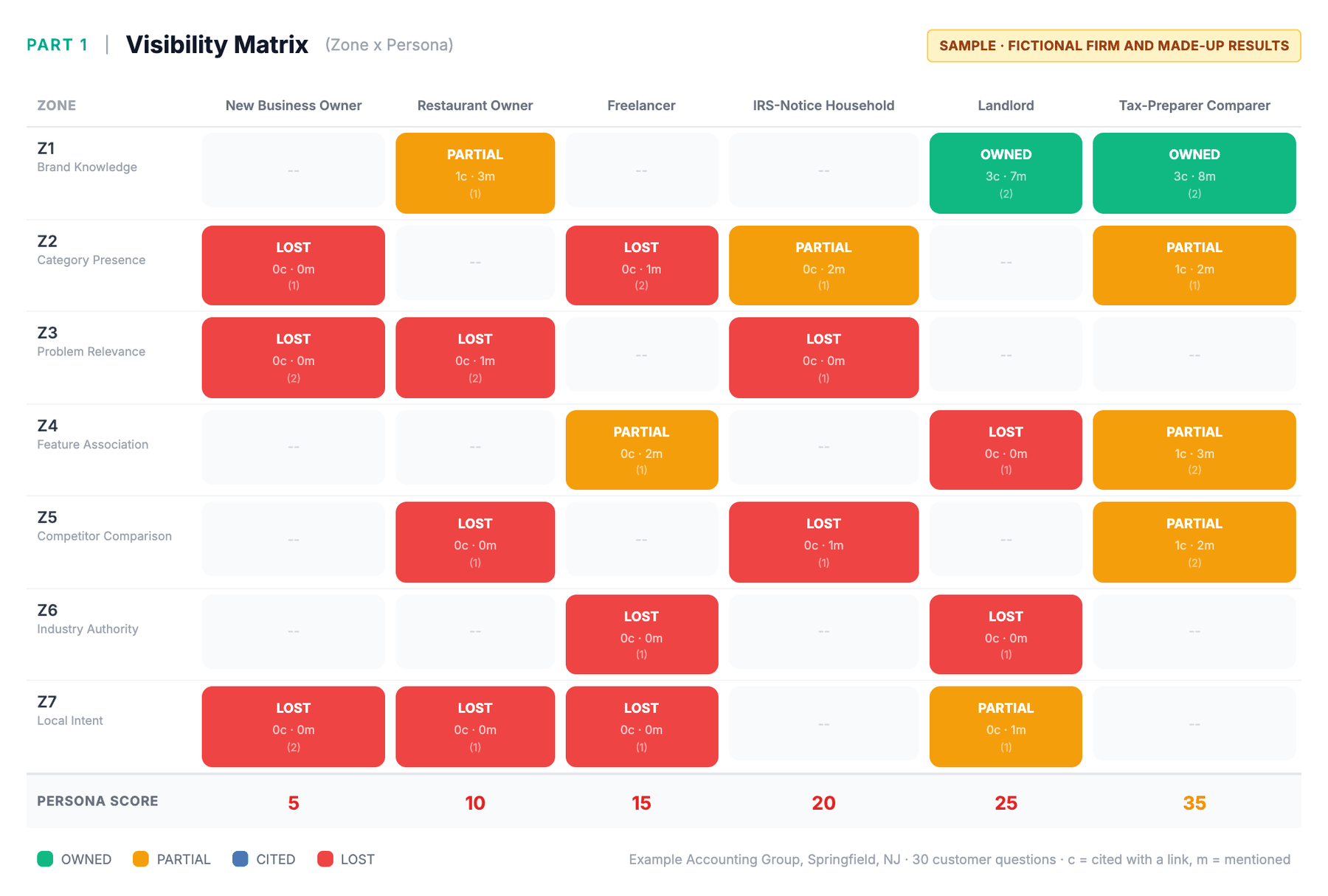
Sample with a fictional firm and made-up results. The layout is the app’s Visibility Matrix. Enlarge Make approved improvements and measure progress
With your approval, we make the fixes on your site and listings, then re-run the same questions each month.
Ongoing service
6 Fixes to Improve AI Visibility (first 4 shown)
- Correct the service listTwo profiles list tax preparation only. Match the website: tax, bookkeeping and payroll.P1
- Complete directory profilesFill in services, credentials and service area on the profiles the firm already has.P1
- Answer local customer questionsA small-business bookkeeping page for Springfield and nearby towns.P2
- Structured data on key pagesMarkup that tells AI tools what the firm does and who it serves.P2
Roadmap
- FirstP1 fixes, after your approval
- NextP2 fixes, after your approval
- ThenSame prompts re-run each month
What you receive
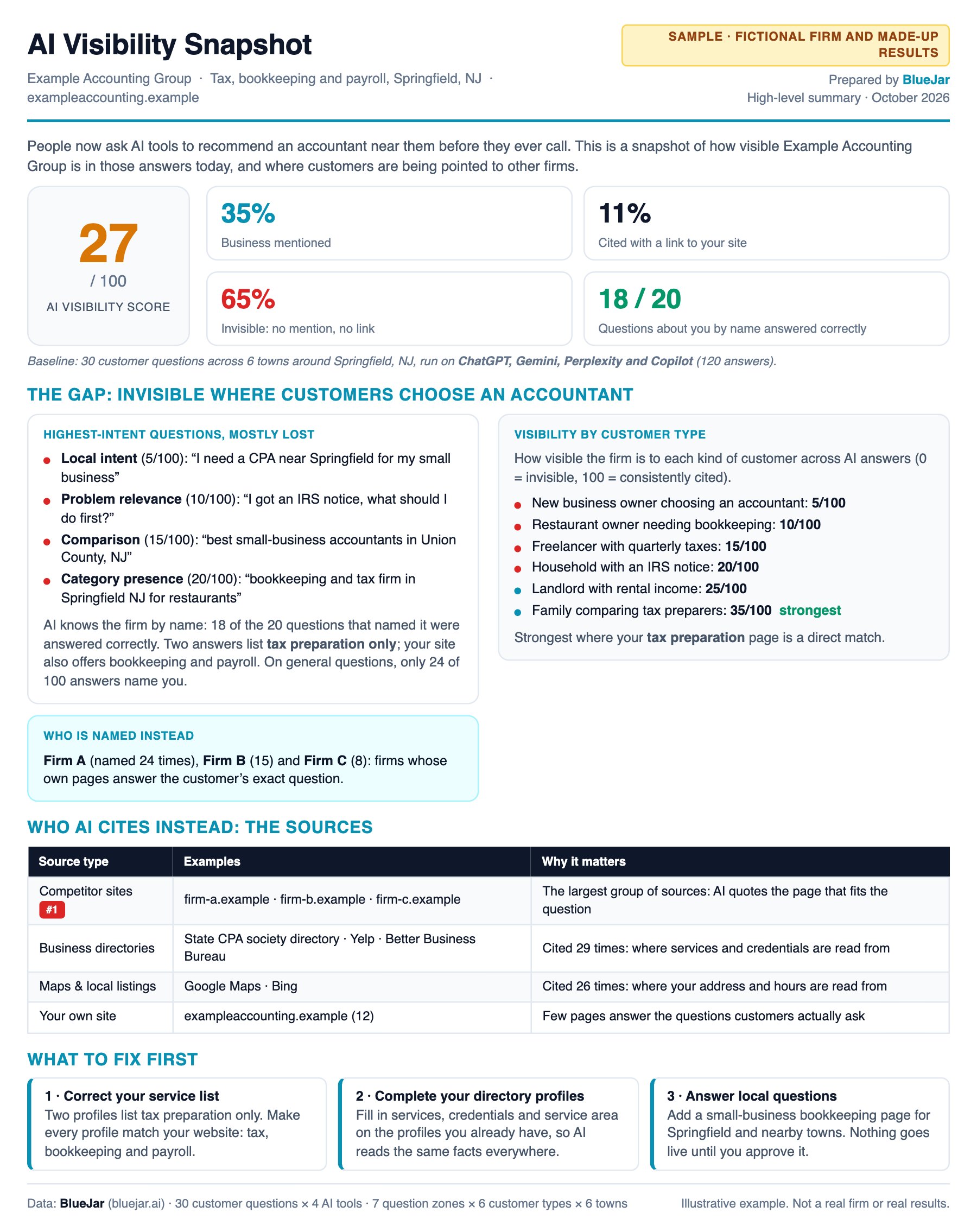
Your snapshot, in three parts
Where you appear
The questions where AI tools name your business, and where they don’t.
Who is named instead
The competitors and sources AI points your customers to.
What to fix first
A short, prioritized list of fixes to start with.
FAQ
Questions
How do I check if my brand appears in ChatGPT?
You can ask ChatGPT category questions yourself and note whether you are named, which is a reasonable smoke test. For an actual measurement you need a consistent prompt set run repeatedly, because answers vary by session and model version. A tracker automates that and reports mention rate, citation rate, and share of voice rather than a single anecdote.
Why does ChatGPT recommend my competitor and not me?
Usually because your competitor is mentioned more often in the sources ChatGPT draws on — review sites, category roundups, editorial coverage, and community discussion — not because their website is better optimised. ChatGPT is reflecting the consensus of the wider web back at the user. That makes third-party presence the main lever, which is why BlueJar reports the Kingmaker sources shaping answers in your category.
Can I improve how ChatGPT describes my brand?
Yes, though indirectly. ChatGPT's description is assembled from what the web says about you, so the fixes are making your own entity information unambiguous and consistent (clear positioning pages, Organization schema, accurate profiles on the platforms engines retrieve from), then correcting stale descriptions at the third-party sources that get cited. Inaccurate pricing and superseded product names are among the most common and most correctable problems.
Can you guarantee more leads or AI recommendations?
We improve your website and business information, then test and refine monthly to strengthen AI visibility and create more opportunities for inbound leads. Results aren’t guaranteed, but each step is guided by measured progress.
First-mover advantage
AI answers name only a few businesses. Be one of them first.
AI search optimization is still new, and it rewards the businesses that move early: winning a recommendation now is easier than displacing a competitor later. See where you stand in your market before your competitors look.
No one can guarantee AI recommendations or leads. We show where you stand, fix what is in your control, and measure the change.