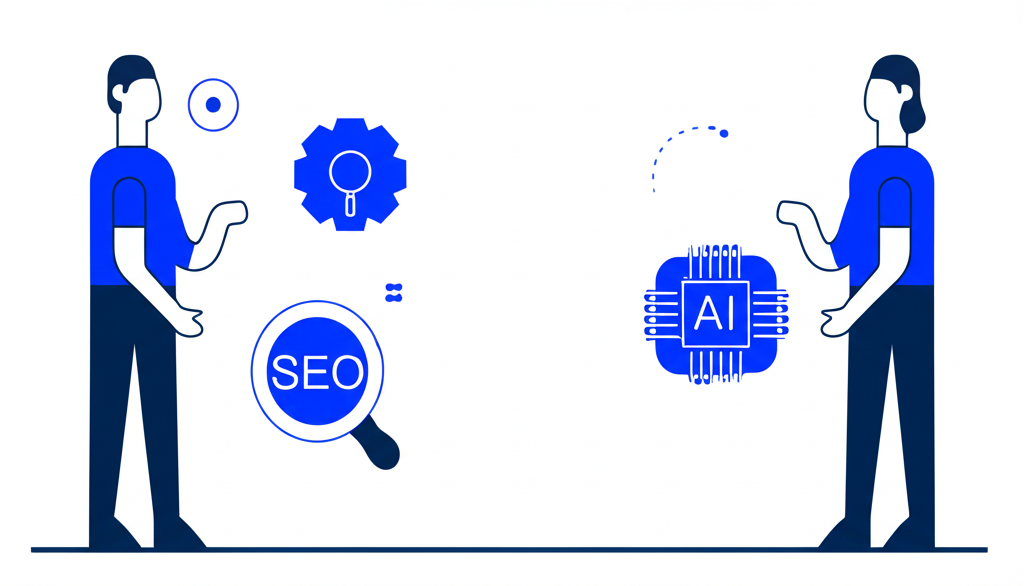
Educate founders, heads of marketing, and SEO practitioners on the fundamental mechanical differences between traditional SEO and Generative Engine Optimization. Establish BlueJar as the authoritative voice on GEO. Position BlueJar’s audit as the fastest way to apply GEO in practice. The reader should finish thinking: “My SEO agency doesn’t know this yet — and I need to get ahead of it.”
The at-a-glance difference
Embed this table near the top of the post — ideally after the intro. It’s the most shareable, screenshot-worthy element in the piece and will drive social shares on LinkedIn and X.
| Traditional SEO | GEO (AI Search) | |
|---|---|---|
| What it optimizes for | Blue-link rankings on Google / Bing | Being cited in AI-generated answers |
| How the engine works | Crawls, indexes, and ranks pages | Synthesizes from trusted source sets |
| Key ranking signal | Backlinks + domain authority | Presence on “kingmaker” sources |
| Traffic model | User clicks a link → visits your site | AI cites your brand → buyer remembers you |
| Ad spend impact | Paid slots compete directly | $0 per citation — no ad auction |
| Conversion quality | Baseline | ~4.4× higher (Semrush, 2024) |
| Time to results | 12–18 months (new domains) | 60–90 days once sources are fixed |
| Where to audit | Google Search Console, Ahrefs, Semrush | BlueJar (400+ prompts, 4 AI engines) |
The hook — the moment the question clicked
Goal: Open with a moment of recognition. Make the reader feel like this was written specifically for them.
- ✓Open with a scene: a marketing lead types their brand name into ChatGPT. Competitor comes up. They don’t. They have great SEO. Their Ahrefs score is strong. None of it matters in this moment.
- ✓Name the question they’ve been carrying: “Is this the same as SEO? Do we just… do more of what we’re already doing?” — and answer it immediately: No. It’s fundamentally different. Here’s why.
- ✓Set the frame for the post: this isn’t “AI SEO tips.” This is a mechanical explanation of two completely different systems — and what each one requires from you.
- ✓Tease the comparison table: “By the end, you’ll have a side-by-side breakdown you can drop in a deck, send to your agency, or use to brief your content team.”
How traditional SEO works (the version your agency knows)
Goal: Establish a clear baseline before the contrast lands. Respect the reader’s existing knowledge — don’t be condescending about SEO.
- ✓Recap the SEO mechanics briefly: crawlability, indexing, keyword matching, PageRank / backlink authority, SERP ranking, click-through to site. The engine’s job is to rank pages that match what was searched.
- ✓Acknowledge what SEO does well: it’s auditable, predictable over time, and well-tooled (Search Console, Ahrefs, Semrush). There’s a mature agency ecosystem built around it. It’s not going away.
- ✓Identify the key assumption baked into SEO: the user will see a list of links and choose one. AI search breaks that assumption entirely — the engine answers the question directly. The link list may not appear at all.
- ✓Land the transition: “SEO optimizes for the moment the user sees the results. GEO optimizes for the moment before that — when the AI decides what to say.”
Tone note: Don’t trash SEO — the reader probably has an SEO agency and doesn’t want to feel like they’ve wasted their budget. Frame GEO as additive and complementary, not as a replacement — at least in this post.
How GEO actually works — the mechanism, not the buzzword
Goal: Deliver the core education. This is the section readers will screenshot, share, and return to. Make it precise and concrete.
- ✓Define GEO clearly: Generative Engine Optimization is the practice of getting your brand cited in the answers that AI engines (ChatGPT, Perplexity, Gemini, Copilot) generate in response to buyer queries — across every stage of the purchase journey.
- ✓Explain how AI engines synthesize: They don’t crawl the full web in real time. They rely on a pre-trained knowledge base plus a selective set of sources they’ve learned to trust. For any given category, that means roughly 5–10 “kingmaker” sources do the heavy lifting.
- ✓The citation mechanism: If a buyer asks “what’s the best project management software for a remote team?” — the AI pulls from the sources it trusts for that category. Being mentioned on those sources is what gets you cited. Your homepage ranking means almost nothing here.
- ✓It’s zone- and persona-specific: A brand can be visible for “enterprise use case” queries and totally invisible for “SMB” queries, even in the same category. GEO maps visibility across intent zones and buyer personas — not just one generic query.
- ✓The feedback loop: AI engines reinforce trusted sources over time. Early citation authority compounds — which is why moving now matters. The brands that build this footprint in 2025–2026 lock in structural distribution advantage.
BlueJar example: This is exactly the mechanic BlueJar audits. The Visibility Matrix maps where a brand is Owned / Cited / Partial / Lost across 7 intent zones × every relevant buyer persona — surfacing exactly which zones and personas the AI ignores.
The 6 key differences, unpacked
Goal: Go deep on the comparison table rows. Give each difference a real explanation — not just a label.
- ✓1. What the engine optimizes for. SEO: ranking a URL on a results page. GEO: becoming part of a synthesized answer. These are fundamentally different outputs. One produces a link. The other produces a recommendation.
- ✓2. Backlinks vs source presence. In SEO, a link from a high-DA site lifts your rankings. In GEO, being featured in a review roundup, listed on a trusted aggregator, or quoted in an industry report is what earns you citations. Domain authority is largely irrelevant here.
- ✓3. Keywords vs buyer intent prompts. SEO targets specific keywords that map to search queries. GEO maps to full buyer-intent prompts — conversational questions like “what should I use to manage client projects?” — which require understanding the AI’s answer pattern, not just keyword density.
- ✓4. Traffic model. SEO produces a click. GEO produces brand recall and shortlist inclusion — often before the buyer ever visits a website. The buyer arrives pre-convinced, which explains the 4.4× conversion lift.
- ✓5. Auditability. SEO is well-audited: you can see your rankings in Search Console today. GEO requires running hundreds of prompts across multiple AI engines, because each engine has different source weighting and the answers change by persona and intent zone. Manual testing is insufficient at scale — this is what BlueJar automates (400+ prompts across ChatGPT, Perplexity, Gemini, and Copilot).
- ✓6. Time to results. SEO for a new domain takes 12–18 months to compound meaningfully. GEO fix plans, once the right sources are targeted, show measurable citation changes in 60–90 days — because the AI engines are already scanning those sources.
What traditional SEO agencies are missing — and why it’s not their fault
Goal: Validate the reader’s concern about their current agency. Create urgency to act independently of existing vendor relationships.
- ✓Most SEO agencies are genuinely good at what they were built for. The playbook — technical SEO, content clusters, link-building — works for Google rankings. It just doesn’t transfer to AI citation mechanics.
- ✓The gap: almost no agency has a GEO-specific workflow yet. They don’t know which sources AI engines trust for your category, how to run prompt-based audits, or how to map buyer intent zones. This isn’t a critique — it’s a market reality.
- ✓The risk for brands: if you’re waiting for your agency to develop a GEO playbook, your competitors who are moving now will lock in citation authority before the field gets crowded. This is a first-mover moment — the equivalent of 2004 Google SEO.
- ✓The practical path: run the GEO audit yourself (or with BlueJar) to get the source map and fix plan — then hand specific action items to your existing content, PR, or SEO team. GEO doesn’t require a new agency; it requires a new brief.
BlueJar angle: The fix plan BlueJar produces is designed to be handed directly to an existing team. Specific URLs to target, specific content gaps to fill — not vague recommendations. This bridges the gap between the new GEO strategy and the existing agency workflow.
Do you need GEO, SEO, or both?
Goal: Answer the practical “so what should I do?” question. Position GEO as additive — avoid triggering defensiveness about past SEO investment.
- ✓If you already have solid SEO: GEO is the unlock — your domain authority and content library create a foundation. Some of your existing content may already be on the right sources. An audit reveals what’s working and what’s missing.
- ✓If you’re early-stage with no SEO: Start with GEO. Getting cited in AI answers builds brand recall faster than chasing rankings that take 18 months to compound. Getting on the kingmaker sources for your category also supports traditional SEO as a side benefit.
- ✓If you’re in a competitive category: GEO is where the competitive edge is right now, because almost no brand has a GEO strategy yet. You can leapfrog competitors in AI citations even if they have a bigger SEO footprint — because the mechanics are completely different.
- ✓The honest answer: You need both, long-term. But the urgency asymmetry is clear — SEO is a mature race with known rules. GEO is a wide-open channel with no incumbents. Move on GEO now while the field is clear.
How to start your GEO audit today
Goal: Make the next step concrete and low-friction. Transition naturally into BlueJar CTA without it feeling like a hard sell.
- ✓Step 1 — Run the prompt grid: Manually test 10–15 buyer-intent prompts across ChatGPT, Perplexity, and Gemini. Record which brands are cited, what sources are referenced. This gives you a rough baseline — but it’s slow and incomplete at scale.
- ✓Step 2 — Map your visibility zones: Don’t just check your brand name. Test across intent zones: brand awareness queries, category comparison queries, problem-specific queries, feature-specific queries, and competitor alternative queries. Each zone has different source weighting.
- ✓Step 3 — Find your kingmaker sources: From the prompt results, identify which 5–10 sources are consistently cited for your category. These are the targets. Check which ones your competitors are on and you’re not.
- ✓The fast path — BlueJar: BlueJar does all of this automatically. Paste your URL → 400+ prompts run across 4 AI engines → Visibility Matrix maps your position across 7 intent zones × every persona → Kingmaker Sources list identifies your gaps → Fix Plan tells you exactly what to do. Free audit, no credit card, results in minutes.
Screenshot suggestion: Place the BlueJar Kingmaker Sources / Fix Plan screenshot here (feat-3-fix-plan.png). Caption: “BlueJar’s fix plan gives you specific URLs to target — not vague advice.”
Conclusion + CTA
Goal: Land the key difference, validate urgency, close with a clear low-risk action.
- ✓Summarize the core distinction in one paragraph: SEO gets you a link in a results list. GEO gets you cited in the answer itself. Different engine, different mechanics, different fix. One doesn’t replace the other — but GEO is the channel where first movers win right now.
- ✓Close with the urgency point: the brands who figure out their kingmaker sources in 2025 and 2026 will compound that citation authority for years. There’s no ad auction for this. No incumbents yet. The window is open.
- ✓Primary CTA: “See where you stand — run a free BlueJar GEO audit in minutes.” Link to
app.bluejar.ai/signup. - ✓Secondary CTA: “Want to walk through your results with someone? Book a 30-min demo.” Link to Calendly.
See your GEO vs SEO visibility side by side.
BlueJar runs 400+ prompts across ChatGPT, Perplexity, Gemini, and Copilot — maps exactly where you’re cited, where you’re invisible, and what to fix. Free audit. No credit card. Results in minutes.
Run Your Free Audit → or book a demo at calendly.com/suresh-bluejar/30min